Your members will want you to act when they encounter anything abnormal on the course but when is it correct to modify the Rules of Golf
Whether it’s a bare area of ground on a fairway or dealing with temporary immovable obstructions in a PGA Tour event, Local Rules are often where people will turn to deal with the issue.
If members perceive something is abnormal at your course, you can be sure they’ll be knocking on your office door asking you to use this mechanism to ease their concerns.
But when is it appropriate to use a Local Rule, how should they be communicated, and what are the pitfalls for clubs and committees that don’t utilise them correctly?
We’ve delved into the committee procedures, found in the Official Guide to the Rules of Golf, for this quick ‘how to’ guide…

What is a Local Rule?
It’s a modification of the Rules of Golf which can be used in both general play and competitions. It is up to a club’s competition committee to decide what is appropriate but they cannot contravene existing Rules of Golf.
For example, the severity of a penalty can’t be altered just because a club committee doesn’t believe the sanction to be fair.
What can be the consequences of pressing on regardless? Committees are asked to consult handicap authorities on whether the scores for a round with an inconsistent Local Rule would be acceptable for handicap.
That said, clubs have got quite a lot of power where Local Rules are concerned – depending on what’s happening on the course or what the competition requirement might be.
How do we go about writing a Local Rule?
The R&A provide a comprehensive number of templates for Local Rules on their website, via their apps, and in the committee procedures in the Official Guide to the Rules of Golf.
These include defining course boundaries, abnormal course conditions, equipment, when and where players can practise, and much more.
These Model Local Rules are designed to cover the most common situations that may arise on a golf course. Where that is not the case, clubs can write their own.
The key is that they are put together in “clear and simple terms” and are “aligned with the purpose statements in the Rules of Golf and Model Local Rules”.
Clubs struggling to find a template or words that suit their requirements are encouraged to get in touch with The R&A rules team.
How should we let members know about Local Rules?
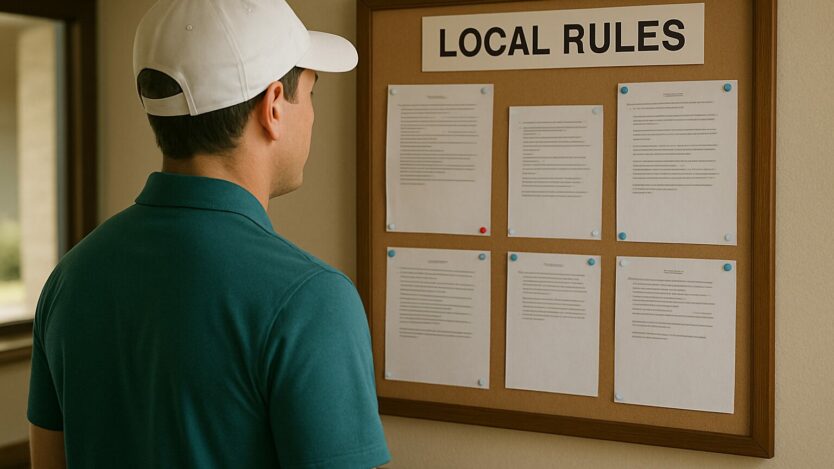
Scorecards, noticeboards, emails – you’ll know these already. What you might not be aware of is how Local Rules should be presented.
Flick through the templates and you may find both a short and full version. While the shorter versions are perfect where space is at a premium, committees are asked to make sure the full Local Rule text is available – whether that’s on show in the locker room, a website, or wherever is convenient.
That should then be communicated to members so they are aware of how to access the full version.
What penalty should we impose for breaching a Local Rule?
The committee procedures say it should normally be the general penalty – that’s two shots in stroke play or loss of hole in match play.
How long should a Local Rule be in operation?
It depends on whether the situation is temporary or permanent. If it’s the former, then it should be removed as soon as the issue it’s addressing is resolved.
Local Rules that may be permanently in place – such as those considering immovable obstructions or the status of boundaries – should be reviewed periodically to ensure they are still fit for purpose.