In the first piece of a new series, we speak to iwGROUP’s Chris Burfield on integrated infrastructure and AI-driven operations.
From the way clubs make strategic decisions to how courses are maintained and members are engaged, technology is reshaping every corner of the game.
In this series, we will explore the innovations redefining modern golf operations and what they mean for clubs, professionals and players alike.
We will look at:
- Data-driven decision making, examining how clubs are using real-time insights to guide everything from pricing and participation to retail performance and coaching outcomes. Smart data is no longer a luxury, it is becoming essential to staying competitive.
- Smarter operations and automation, where integrated software, booking systems and AI-powered tools are streamlining administration, freeing up staff time and improving profitability.
- Groundbreaking agronomy and maintenance technology that transforms sustainability, efficiency and playability, from GPS-guided machinery to advanced irrigation and turf analytics.
- Member experience and engagement technology, where apps, personalisation tools and digital communication platforms are helping clubs build stronger, longer-lasting relationships.
In this first installment, we’re in conversation with Chris Burfield, Joint CEO at iwGROUP, about the growing importance of integrated technology infrastructure, the role of AI in day-to-day club operations, and how clubs can use connected systems to drive both efficiency and new revenue opportunities.
Can you explain what iwGROUP does and the types of technology solutions you provide to golf clubs?
We help golf clubs modernise the core technology infrastructure that supports both their operations and their member experience.
Our focus is on the systems that form the digital backbone of a club — including WiFi and networking, telephony, audio visual systems, access control, CCTV security, and managed print services. These technologies underpin how staff communicate, how facilities are secured, and how members interact with the club environment.

What differentiates our approach is that we provide these technologies as a fully integrated ecosystem rather than as isolated solutions. Traditionally, clubs may work with multiple suppliers for networking, security, telephony, and AV systems, which often results in fragmented support, duplicated costs, and limited visibility across the technology estate.
By bringing these platforms together under a single partner, clubs benefit from aligned support agreements, reduced operational complexity, and a much clearer understanding of how their technology infrastructure performs as a whole. That holistic view is increasingly important as clubs begin to adopt AI-enabled systems and data-driven decision making, which rely on strong integration across platforms.
How is technology currently changing the way golf clubs operate day-to-day?
Technology is now embedded across every part of the club environment, and we’re seeing a shift toward more connected and intelligent operations. This means that the traditional approach of different suppliers for each technology becomes inefficient and expensive. There’s simply no need to have different systems for CCTV, telephony, access control, visitor management, WiFi etc.
Reliable WiFi and networking infrastructure is the foundation that supports everything from booking systems and POS platforms to staff devices and member connectivity.
Communication systems like modern cloud telephony allow clubs to manage enquiries and bookings more efficiently, while CCTV and access control systems provide better oversight of facilities and improve overall security.
Where this is evolving further is through AI-powered monitoring and automation. AI can analyse call patterns within telephony systems, detect unusual activity through CCTV, and monitor network performance to identify issues before they affect operations.
When all of these systems are designed to work together, managers gain far greater operational visibility and control, which ultimately improves efficiency across the entire club.
What are the biggest operational challenges club managers face today that technology can help solve?
One of the biggest challenges for club managers is managing a complex facility with limited resources.
Many clubs operate multiple technology systems supplied by different vendors, each with separate contracts, support arrangements, and upgrade cycles. This can create unnecessary cost, confusion, and inefficiency.
By consolidating technology platforms under a single, integrated technology partner, clubs can simplify their operational environment significantly. Support agreements can be aligned, systems are designed to work together from the outset, and there is clear accountability for the overall performance of the technology infrastructure.
AI will also increasingly help reduce operational pressure. Intelligent monitoring systems can detect network issues before they cause disruption, analyse patterns within telephony platforms, or enhance security through AI-enabled CCTV monitoring.
The result is a more stable and predictable technology environment that allows managers to focus on strategic priorities rather than troubleshooting disconnected systems.
How can golf clubs use technology not just to save time, but to generate new revenue opportunities?
Technology has traditionally been viewed as a cost centre within clubs, but increasingly it is becoming a revenue enabler.
Professional audio visual systems allow clubs to host conferences, corporate meetings, and events with high production quality, creating additional income streams beyond traditional golf activities.
Reliable WiFi infrastructure is now essential for event venues and hospitality spaces, where connectivity expectations are extremely high.
AI also has the potential to enhance commercial performance by analysing operational data to identify trends and opportunities — whether that’s understanding peak facility usage, identifying demand for events, or improving responsiveness to visitor enquiries through intelligent telephony systems.
When all of these platforms operate within a connected infrastructure, clubs can gain much clearer insight into how their facilities are being used and where new revenue opportunities exist.
Many clubs worry about complexity when introducing new systems. What advice would you give managers looking to adopt new technology successfully?
The key is to approach technology strategically rather than implementing individual solutions in isolation.
Everything within a modern golf club ultimately depends on strong networking and connectivity, so building that foundation first is essential.
Clubs should also think carefully about integration and long-term scalability. Choosing systems that can communicate with each other — and ideally working with a single technology partner who understands the entire infrastructure — makes future upgrades and innovation far easier.
This is particularly important when considering AI adoption, because intelligent systems rely on access to connected data across multiple platforms.
Ultimately, technology should simplify operations. When systems are integrated and supported under a unified strategy, they become far easier for staff to manage.
Looking ahead five years, what role do you think technology will play in shaping the modern golf club?
Over the next five years, golf clubs will increasingly operate as connected, intelligent environments.
Networking infrastructure will support a growing range of smart systems across the club — from communications and security to hospitality and member engagement.
AI will play a major role in this transformation. We are likely to see AI-assisted security monitoring through CCTV, intelligent telephony systems that manage and prioritise enquiries, predictive maintenance for infrastructure, and automated operational insights generated from network and facility data.
The clubs that invest today in integrated, scalable infrastructure will be best positioned to adopt these innovations as they mature.
iwGROUP focuses heavily on integrating multiple technology systems within a club. Why is bringing data from different platforms together so important for golf club managers?
Integration is essential because every technology platform within a club ultimately relies on the same digital infrastructure.
When systems such as networking, telephony, CCTV, access control, AV, and printing environments are designed to work together, clubs gain a much clearer view of how their technology supports operations.
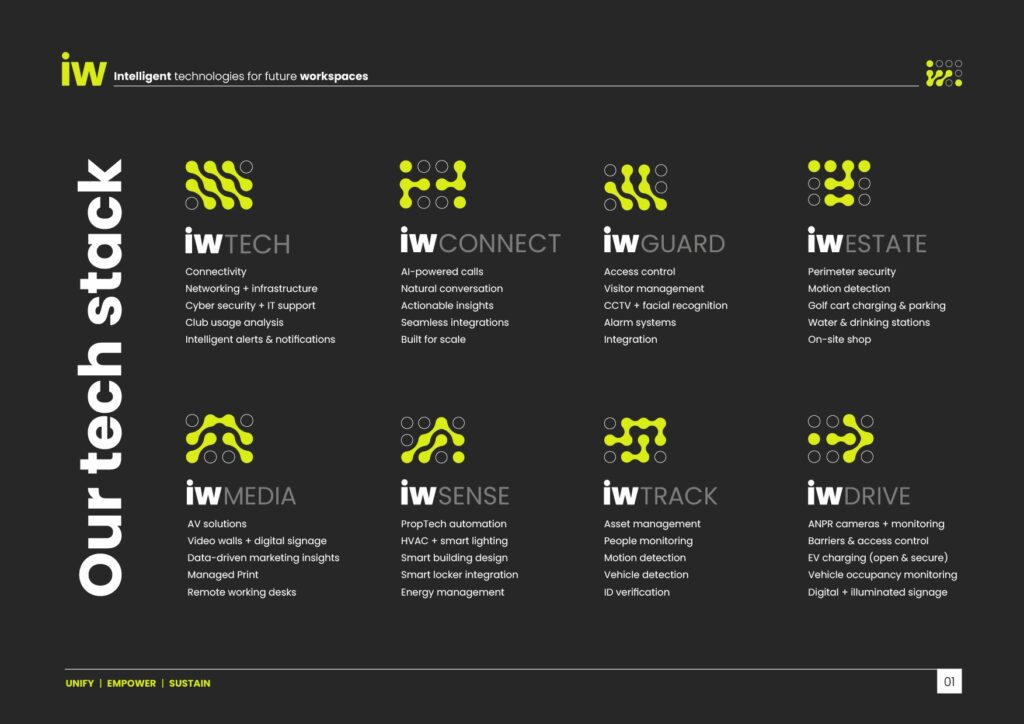
Working with a single supplier also creates complete oversight of the technology ecosystem. Instead of managing multiple vendors and contracts, clubs benefit from a unified strategy, aligned support, and a clearer understanding of performance across the entire infrastructure.
This integration also maximises return on investment. When platforms share data and operate together, clubs can extract far more value from the systems they deploy.
You talk about AI-driven insight and behaviour analysis. What types of real-time data should golf club managers be paying attention to today that perhaps they weren’t five years ago?
Five years ago, most clubs were focused primarily on traditional operational metrics.
Today, much more valuable insight comes from real-time operational data generated by connected infrastructure and smart systems.
For example:
- Network performance and connectivity patterns, ensuring digital services run reliably across the club
- Telephony analytics, including call volumes, missed enquiries, and response times
- Facility access patterns through access control systems, showing how buildings and spaces are used
- Security monitoring through AI-enabled CCTV, which can identify unusual behaviour or operational risks
AI can analyse this information continuously and highlight patterns or anomalies that managers may otherwise miss.
As clubs continue to digitise their operations, this shift from static reporting to real-time intelligent insight will become increasingly important.
Key Takeaways
- Integrated systems are replacing fragmented tech setups, giving clubs greater efficiency and control.
- AI is helping managers move from reactive problem-solving to proactive decision making.
- Technology is becoming a commercial driver, supporting new revenue as well as operations.