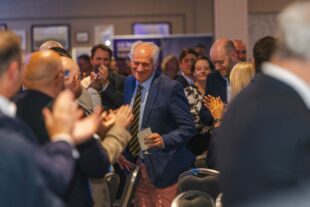
Eddie Bullock, golf consultant and GCMA board member, takes you through his tenets of leadership and how they can ensure you run a successful club.
There are four areas of leadership for a golf club manager. There is the leadership of teams and staff, the leadership of the membership, dealing with boards and showing leadership to the outer community.
We’ll take each of these in turn but, in general, the manager now needs so many more competencies and skills to able to deliver the wholesome product for everybody.
Each and everyone expects something different. You have to get your staff to work alongside you, to involve them and include them.
Great leaders give everyone something to believe in – not something to do. Communicate the purpose where everyone should feel valued.
Memberships are so diverse and you must show good communication skills – whether that’s speaking to people who are eight or 88-years-old.
We’re always learning to deal with boards and you have to make sure you are very clear and articulate exactly where the business is going when communicating with them.
And being a manager of a golf club also means showing leadership to the outer community, whether that’s in local or national situations.
Teams and staff
The key for any leader is to make sure they get the right people around them. That doesn’t happen straight away. You need to share values that people understand and work with you on.
They could be personal values but every business should have their own values. The most successful clubs I have been involved with manage to leverage their shared values to shape a positive club business culture. That, in turn, creates a competitive advantage, which the team are going to work behind. Far too often leaders fail to connect and adopt values within their workplace.
A good manager is a mentor. You’ve got to appreciate you are there to teach people to move forward. There is no question that people should be completely working together and striving for a perfect result in everything.
For example, develop habitual weekly dash meetings, where you get together and assess where you are going and what you want to achieve. It becomes a learning school but you’ve got to get people in a team that are prepared to take responsibility and ownership.
If you give those people responsibility, even if they don’t deliver all the time, they know where they stand and you get a more harmonious approach throughout the whole membership structure.
Make sure your teams are proud of where they are working.
Give them the opportunity to speak. Organise internal group discussions, promote inclusiveness and create curiosity – there is nothing worse than a manager that doesn’t listen.
You’ve got to allow them to think laterally, and be able to listen to every word in return. If they have got an opinion, write it down. Don’t let them get two thirds of the way through and then try to answer it or contradict them.
You’ve got to have an opportunity for those people to progress and flourish within your business and so sticking together is important.
You’ve got to be able to explain what to do and why. You must get input from your team. Your job is to inspire the team to make a commitment to the brand values.
Empower the team to work independently, but to also work together. Motivating diverse teams to perform well is a leadership art.
Get your teams together so each of them can understand what everyone does. The greenkeeper needs to know what the waitress does and vice versa.
The more successful businesses and clubs get those people together because they need to work collaboratively and work together to make it a successful business. You then drive a high performance culture. That sounds very grand but it does work and you will be surprised how effective it all becomes – perseverance being the golden key.
Leading the membership
There is one clear thing these days.
People want to see you. You have got to stand out as the leader in that business. When I look at websites, I want to see to whom I am going to be speaking.
I’ll get onto a website and I’ll find the captain and the president, but the leader of the business needs to be the name that is highlighted a little bit more with their key support team.
You’ve got to be visible and know when your membership is going to be there. You’ve also got to accept that you are not just in the golf club business. You are actually in the golf hospitality business. You are in the golf entertainment business.
Furthermore, you are in the people business. Get to know your membership better as they can choose where they want to share their recreation time. They will share it with a leader that cares!
It is not the London Palladium but you are, relatively, on show. You have got to be able to stand up and communicate with each and every member that comes in. You have to be seen to be attending when members are there.
Find methods to communicate clearly, but that doesn’t necessarily mean always having an open door. The open door effect means you will get people knocking left, right and centre and there is so much to do now in the day-to-day golf club business.
Instead, hold clinics – where you get together and you are there at a particular time or day and you’re fairly open. Once every three months, find the opportunity to stage an evening. That could be a wine evening or maybe the golf is on.
Whatever it is, find the time to inform people about where the club is, what you are doing and how it is being taken forward.
It’s just good, solid, public relations from the general manager or the leader of the club.
Dealing with the board
You’ve got to get to know your board. One of the questions I think every general manager should ask at an interview is ‘how do you expect me to communicate with you?’
It’s all down to relationships. You have got to get to know what your board members do for a living, learn about their insights into the club and find out how much they know about their club.
In terms of moving the club forward, my success has really been to outline opportunities and deliver a white paper.
It works in various parts: An introduction and an outline of the challenge, what the problems are you are trying to solve, the background – including some historical facts or issues that have occurred in the past – and the idea along with the pros and cons.
If you feel strong enough, you make a recommendation to move forward whatever the project, or issue, is within the club.
I’ve found this clearly gives the opportunity for some great dialogue and conversation and, more often than not, that way of communicating with the board gets to a decision a lot quicker.
The board is there to set the policy. The manager is there to deliver that policy and manage the club. Displaying the professional leadership skills in guiding and influencing the board is the job that the club employed the general manager for and they should be used as the resident experts.
Good leaders also know how to fail. No one intends to go and fail. I have had failures but it is important to be professional, to accept those failures and learn from them, to assess them and find the solutions.
The white paper is fairly straightforward and, at the end of the day, a meeting is there to make a decision. What I am doing, as a leader, is making the decision pathway a little bit easier.
Leading the outer community
Effective leadership now goes beyond the actual club boundaries. Club managers that embrace the outer community can deliver a powerful message. Your internal culture is now a core part of your external brand.
It is far more critical now, in terms of making the non – or infrequent – golfer understand what the benefits a club community can offer as an escapism. Club leadership means clearly defining your social media stance to the outer community and this must not be taken lightly.
Creating close associations with local businesses, business networks and local governments is all a part of displaying the leadership authority for the club business.
Who is Eddie Bullock?
Eddie Bullock is a former managing director of Woburn and captain of the PGA. He has served as a non-executive director for Golf at Goodwood and has been a member of the GCMA board since 2014.
He’s also a non-executive director of recruitment firm Colt Mackenzie McNair and through Eddie Bullock Golf Consultancy has provided management and staff training for a whole host of golf clubs, preparing them and their people for success.
To find out more, visit eddiebullockgolf.com