The project is helping Lewes Golf Club cut energy costs, boost sustainability and secure long-term carbon savings without capital outlay.
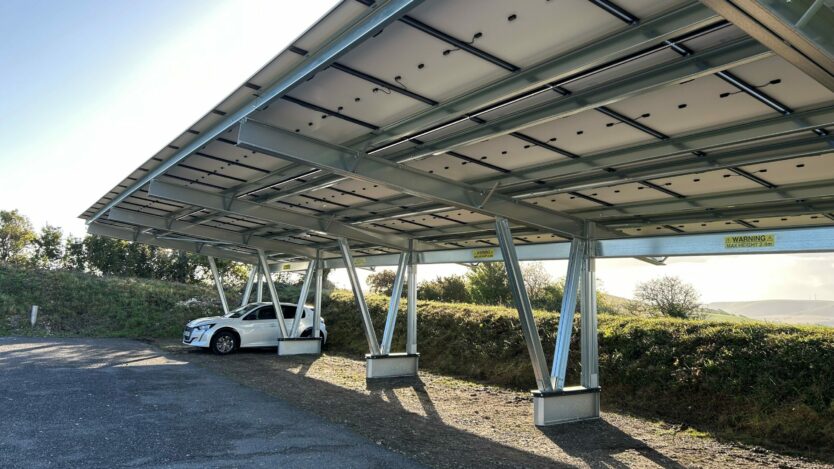
Lewes Golf Club has completed the installation of a solar carport, providing a long-term renewable energy source with no capital outlay for the project.
The club explored multiple renewable energy options, including both wind and solar, assessing installation, servicing, and planning requirements. Practical limitations soon became apparent, but the car park emerged as a promising site for a solar carport.
However, the initial cost estimates exceeded the club’s budget, putting the project on hold.
“After looking at and costing the possible ways of installing renewable energy systems of wind and solar, and bearing in mind installation, servicing and planning requirements, we realised while there was potential, Lewes Golf Club’s situation severely limits what we can do,” explained General Manager Mandy Quick.
“Solar became preferred and both ground and roof options considered. Ground was dismissed by the planning authority and the roof option was not looking good due to the pitches and orientation not being favourable. Coupled with the fragmented slopes and structural concerns, as well as incoming errant golf balls, it became unviable. The car park looked like a possibility with a carport. The initial quotes were way out of our range and the scheme was initially shelved.”
A new opportunity arose when a renewable energy provider presented a proposal requiring no capital outlay from the club. Under the arrangement, the provider builds, owns, and maintains the carport, while the club purchases electricity generated on-site at an agreed unit rate. After 25 years, ownership transfers to the club, allowing long-term benefits from the installation.
“A flier arrived from RenEnergy with an outline of their proposals,” added Mandy. “This was followed up and a spec produced that looked possible. Their proposal is no capital outlay from the club; they build, maintain and own the carport; we buy our electricity from the carport. We have agreed a unit rate per kWh for 25 years that essentially is paying back the loan for the construction. After this period, the installation belongs to LGC.”
The solar carport will generate more energy annually than the club consumes, while also providing capacity to support future electrification of the gas boiler and cooker. Three EV charging points have also been installed to accommodate growing demand.
“LGC is net carbon neutral. We will never get to grid-free due to seasonal changes but we will generate more than we use annually. We have future-proofed our demand. The gas-burning boiler and gas cooker will be converted to electric as and when they need replacing. Capacity is there to support this. Three EV charging points are also included.”
Members and the Finance Committee were closely involved in assessing funding options. After careful consideration of loans, sponsorship, grants, and donations, the no-capital model was determined to be the only realistic way to achieve the project. The response from members has been “very positive”.
“Some, including me, asked, ‘What’s the catch?’, but there isn’t one,” Mandy revealed. “They sell to us, the excess is sold to the grid so they recoup their outlay and make a good profit. There was also some debate about this model v loans. The Finance Committee was against the risk factors of loan repayments, especially for a project of this size and cost. Sponsorship, grants, crowd funding, donations and benefactors were all considered at length but would not come close to covering the outlay. This model became the only way to achieve our goal in a realistic time frame.”
The carport complements the club’s broader sustainability initiatives, including native species promotion, composting, and sustainable water extraction, and could pave the way for further renewable projects across the site.
“This has to be their first step. Far more can be achieved with this model due to no capital outlay. The greenkeepers shed and the bore hole pump are distant from the clubhouse. We will look at this process as a way of funding the installation of a PV and battery storage to provide for their demand. Machinery can become electric reducing fossil fuel consumption and the bore hole pump will be net carbon zero.”
Key takeaways
- Explore alternative funding models. Power purchase agreements can remove capital cost barriers, making large-scale renewable energy projects realistic for clubs of all sizes.
- Plan for future energy needs. Building capacity for electric boilers, cookers, and EV charging ensures projects remain viable as demands evolve.
- Engage members and committees early. Transparent debate about funding options and risk helps secure buy-in for ambitious sustainability projects.