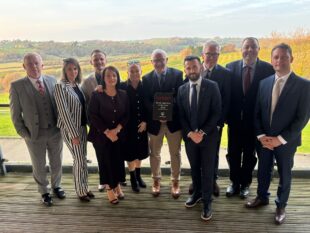
Candi Watkins explains why modern clubs must balance heritage, participation change and long-term operational resilience.
Golf clubs must focus on sustainability, inclusivity, changing participation models and long-term operational resilience if they are to remain viable in the years ahead.
Balancing heritage with modernisation, responding to new ways people engage with the game, and building more resilient business models are now central management challenges, according to Ponteland General Manager Candi Watkins.
Candi was a finalist in the GCMA Newcomer of the Year category in 2025, having made a major impact at Sharpley, where she helped deliver a remarkable turnaround in operations and culture, before stepping into her current role.
Speaking about the future direction of club management, she believes clubs must be prepared to adapt how they operate while remaining true to their identity. Candi argued that sustainability and inclusivity should sit at the centre of strategic decision-making, rather than being treated as standalone initiatives.
She believes clubs that invest in modern operating practices and facilities will be better placed to attract broader audiences and support participation growth.
“Sustainability and inclusivity are at the forefront of where the game is going,” she said.
“Clubs need to balance protecting their history and heritage with being flexible and modern in how they operate, from adopting technology that improves the member and visitor experience, to developing facilities that appeal to a wider audience and grown participation.”

She also points to clear evidence that participation patterns are shifting. While traditional membership structures remain important, alternative ways of accessing the game are becoming more prominent and are influencing how clubs must shape their offer.
Embracing these changes, rather than resisting them and relying on the ‘this is how we’ve always done things’ approach, will be critical for clubs seeking to remain competitive.
“Participation trends like iGolf, casual play and virtual golf, show that the traditional membership model is changing. I believe that clubs that embrace these changes, will thrive.”
She also stressed that sustainability must be understood in broader terms than environmental responsibility alone. Financial stability and operational resilience are equally important as clubs look to manage rising costs and long-term uncertainty.
Candi believes clubs need to actively futureproof their operations and reduce reliance on single income streams in order to strengthen long-term sustainability.
“Sustainability also isn’t just about the environment, it’s also important to build financial and operational resilience,” she added. “We need to future proof our clubs’ operations and look to diversify revenue streams.”
Key takeaways
- Modernisation and heritage must coexist: Protecting a club’s identity while adapting operations is critical to future relevance.
- Participation is evolving: Flexible formats and non-traditional engagement models are reshaping how people access golf.
- Sustainability is multi-dimensional: Environmental responsibility must sit alongside financial and operational resilience.