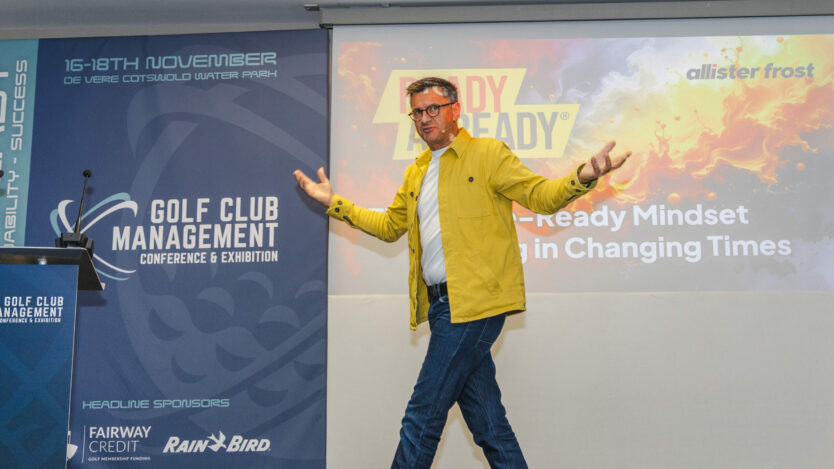
Conference keynote speaker Allister Frost shares five future-ready lessons for today’s golf club managers.
Golf club managers are navigating an increasingly complex landscape. Rising expectations from members and visitors, staffing pressures, financial constraints, technological change, environmental concerns and wider societal shifts all demand attention and action.
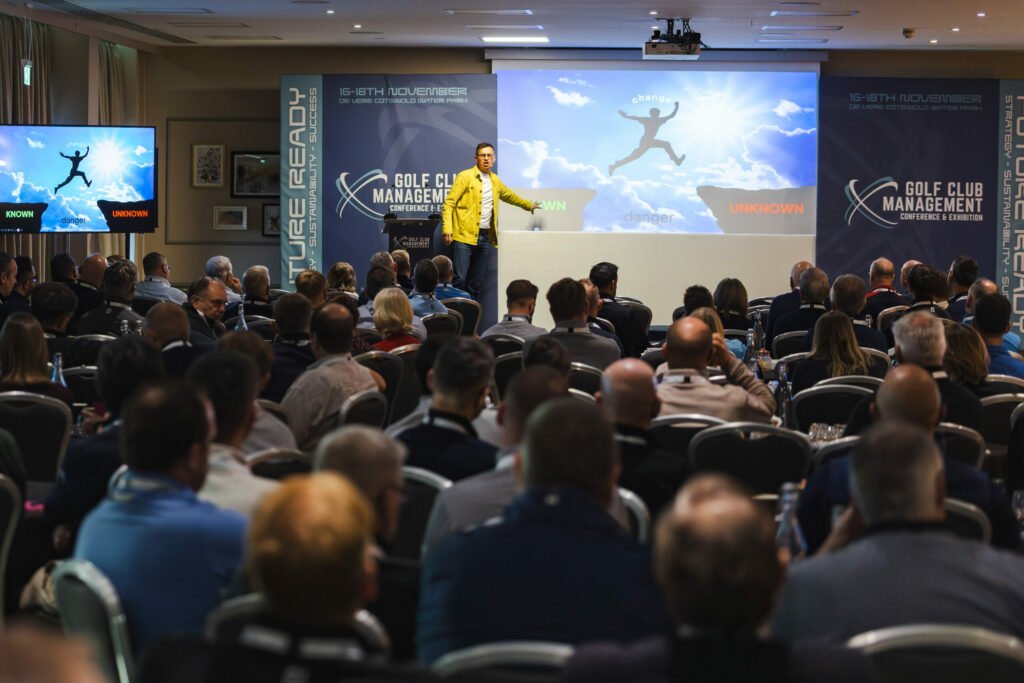
Speaking at the Golf Club Management Conference and Exhibition, former Microsoft Digital Strategy leader and global speaker Allister Frost offered a framework not for predicting the future, but for preparing for it.
His message was clear: progress does not require dramatic reinvention, but a mindset built around small, deliberate and continuous improvement.
Below are five key insights from Frost’s session, presented as practical tools for club managers looking to build resilience and momentum.
1. Accept that change and uncertainty are inseparable
Frost began by reframing change as something to be embraced rather than feared, emphasising that uncertainty is not a sign of failure but a natural companion to progress.
He explained: “Change and uncertainty are two sides of the exact same coin. You cannot have meaningful change without some uncertainty. You simply cannot.”
He was keen to reassure managers that most decisions in club management are not existential risks.
“There are very few decisions that any of us make in our working lives that are actually dangerous,” he said. “Let’s bring it back down to reality – it’s not dangerous, it’s a bit scary. And we can do it.”
2. Beware the comfort zone
One of the biggest barriers to progress, Frost argued, is familiarity. Processes that “work” can quietly prevent improvement simply because they go unchallenged.
“Your comfort zone tells you how things are, how they should be, not how they could be,” he said. “It’s a psychological safe place where you feel at ease because you’ve seen this before, you’ve done it… and you don’t have to work hard.”
He encouraged managers to question long-standing practices that may no longer suit a faster-moving world.
“The people that held your role in the past, they could keep things the same because the world wasn’t moving as quickly as it is today,” he warned. “Things have changed. We need a new era, a new generation of managers.”
3. Assume everything is already obsolete
Central to Frost’s “future-ready mindset” is a deliberately provocative idea: if something works today, it is already out of date.
“Today, if something works, it’s already obsolete,” he insisted. “It means that every process, every system, every tool, how we organise this event — everything about everything we do — is already out of date because someone, somewhere, somehow, has already figured out a better way to do it.”
Rather than being demoralising, Frost framed this as liberating.
“When you think today, everything’s obsolete, it gives you absolute permission to improve something… Another day, another opportunity to improve something,” he said.
4. Focus on small, continuous improvements
Drawing on his technology background, Frost urged managers to move away from infrequent, large-scale change and towards incremental progress.
He said: “What happens today? Your phone, your laptop, your tablet, updates itself frequently… That, to me, is a fantastic recipe. That’s how you should update yourself: small, continuous updates every day. Learn something new every day.”
5. Identify what is inevitable — and plan for it
Rather than reacting to problems as they arise, Frost challenged managers to think more deliberately about what they know will happen in their clubs.
“There is so much about your work that is inevitable,” he reasoned. “There are things that you know are going to happen… We need to spend more time thinking about what is inevitable about my situation, what is definitely going to happen.
“I want you to know what those inevitable things are, have them on your radar, and then pick them off one by one.”