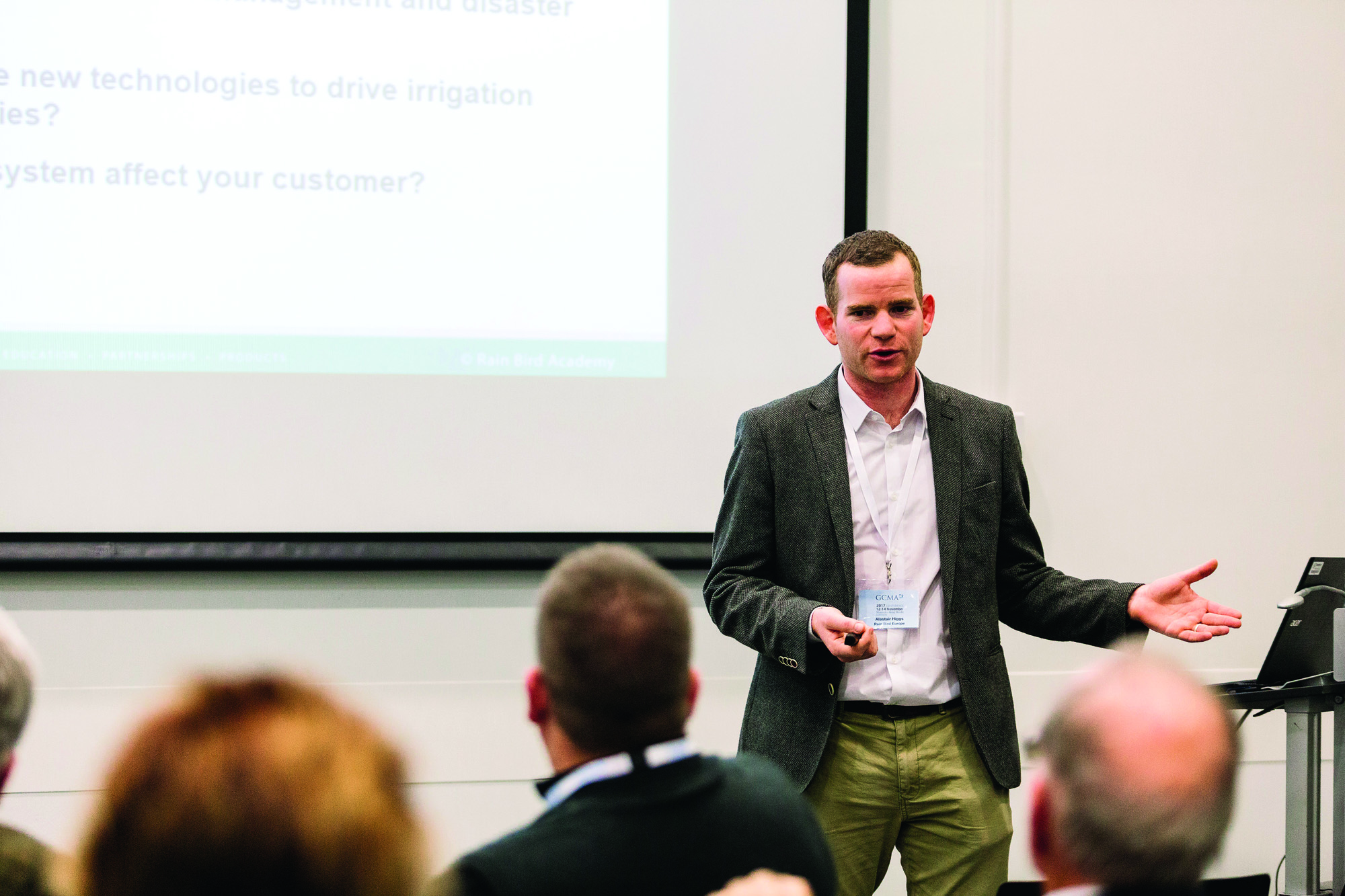
Alastair Higgs, golf district manager UK & Ireland at Rain Bird Europe, talks about the importance of good irrigation.
We all know about the importance of course renovations but isn’t keeping on top of existing irrigation systems just as important?
Many golf club irrigation systems installed back in the ‘80s, in the golf boom in the ‘90s and early 2000s are coming to the end of their working lives. Clubs may be facing the prospect of total system renovation because, after 30 years, what they have now simply isn’t reliable enough to deliver the playing experience that golfers demand. And given this year’s been the hottest and driest summer since 1976, it’s time to think differently about irrigation, drive irrigation efficiencies and use less water.
 Is a good irrigation system fundamental to the effective running of a golf course?
Three of the largest capital investments a club makes are the course, club house and maintenance sheds. Equally important is capital invested in irrigation system infrastructure which lasts 30 to 40 years too.
What are the problems an old, failing irrigation system brings for a golf course and course manager?
Golf architects, general managers, course managers and greenkeeping staff want the best course possible. No one’s more passionate about the course than the turf manager running it. It’s personal. It’s all about cost, budget and the bottom line. Having a firm grasp on costs, including the labour cost of repairs, maintenance and increased manual watering, the course manager knows exactly how much is spent on irrigation and can make more informed decisions. In my experience, this isn’t always the case.
The details are lost when everything’s included in clubhouse utility bills. Something as simple as having a separate electricity meter on the pump house could give accurate running costs. I reckon 99% of clubs could tell you precisely how many pints were spilled in the bar yesterday yet 85% probably couldn’t tell you how much they spent irrigating last night. Work out if spilt beer or overwatering will have the greatest effect on the bottom line!
 Systems break down for two main reasons. The first is ageing hydraulics; pump and pipe networks. Old PVC pipe networks are failing. We’ve moved on a long way in terms of pipework technology and polyethylene (HDPE) pipe, used by gas networks, is more robust, reliable and lasts longer. The second is failing electrics. Cable, joint and decoders have advanced too with modern integrated control technology. Buried underground and working, they’re easy to forget and they shouldn’t be, because at some point, they will fail.
If there’s negative feedback or complaints from golfers, this could be flagging up the performance limitations of the current system.
So are you saying a modern, efficient system can save a club a lot of money?
The bigger the system, the more you can fine-tune irrigation, water less and save money both directly and indirectly by maximising all other inputs. A thorough cost of ownership appraisal works out up- front spend and cost of ownership over time – likely investment and likely return. A practical example might to be looking at moving from single row fairway to double row fairway irrigation. That work needs to be done on a case-by-case basis, looking at every option. Everyone understands installing more technical processes means more components to start with but, over 30 years, the club reaps benefits, cost-wise and because the course will play as the architect originally intended.
A lot of older irrigation systems need replacing or will do so soon. You’re saying ‘get to grips with it?’
Deciding how long to wait before addressing renovation is difficult. No- one usually waits for their car to break down completely before buying a new one. At some point, you start weighing up whether it’s more cost effective to continue to service and maintain your old car or buy new.
Every club manager should start by answering five key questions:
1. What does it cost to run our system on a daily basis?
2. How much does irrigation cost our club each year?
3. What’s spent on preventative maintenance and upgrades?
4. How do we measure water usage and electricity for course irrigation?
5. What’s our approach to irrigation risk management and disaster planning?
When it comes to risk management and disaster plans, addressing potential risks is critical. You might have a reservoir source that allows wall to wall watering but what happens if that source gets contaminated in June? You could switch to mains feed, but can the club then afford to water at the same rate? From personal experience, it’s worth tackling those difficult questions and getting a plan in place.
You’ve outlined some of the challenges. What are the benefits of having a modern system in place?
The benefit is being able to keep the course, reliably, in a target ‘zone’, whether that’s from an agronomic or playing perspective. Without that, costs rise and the course can’t be set up and kept at the best possible standard. The turf manager plays safe. A modern system gets you nearer to what I call ‘the cliff edge’, so customers get the best golfing experience and the club gains a P&L benefit.
How do you work with clubs to make it straightforward for club managers apprehensive about going through the process?
Our priority is understanding the issues and challenges at the earliest stage possible. First and foremost, we support the club to maximise what it has, assess how customers and the business are affected and look at any likely investment – whether that’s add- ons or a whole new system, if there’s a strong enough business case. Next comes purchasing equipment, solutions, training or advice. The two most important aspects are water source and a nozzle that delivers water evenly.
All the stuff in between is about getting water to individual nozzles reliably, easily, as and when required. If the water source and nozzle are not correct then this will have the biggest adverse effect on system performance. We work closely with leading consulting partners across the globe, bringing in specialist support and technical expertise at exactly the right level, depending on what’s required. The way a course is designed, grass cultivars and water storage, for example, have a major impact on water requirements. There’s no point in having a magnificent irrigation system without water storage.
The service you’re offering then is from genesis to execution?
From reservoir to rotor is how we put it. Rain Bird invented the very first horizontal action impact drive sprinkler in 1935, which revolutionised the food production industry and ushered in a new era of irrigation. Irrigation is our sole focus – it’s what we do. We manufacture innovative products and solutions engineered to deliver best practice, and we provide irrigation expertise.
How can clubs add new technologies onto existing systems to drive efficiency?
What’s unique to Rain Bird is that our latest software runs with all our systems dating right back to the 1980s. The original computer, if you wheeled it in, could run the latest hardware. Rain Bird offer timeless compatibility. Every single product is future proofed and backwards compatible. When you put a Rain Bird system into the ground it’s the start of a 30-year partnership.
Every new product development, every technical advance, every time something gets more efficient or is easier to use, it’s available for Rain Bird customers. When you come into the Rain Bird family as a valued partner, you can be confident you are buying the opportunity to maintain your position against all your competition for years to come.
It’s quite special to be involved with a global company that delivers that long-term commitment to partnership. What’s critical is working out the impact course irrigation has on your customer’s experience and the club’s profits. As I often say, as irrigation specialists, we’re not only in the golf business, we’re in the customer experience business.
Who is Alastair Higgs?
A keen golfer, Alastair started his career as a greenkeeper with
Crown Golf in 2004, becoming head greenkeeper at Donnington Valley Golf Club in 2008, and was then appointed as course manager at Windlesham Golf Club in 2012. He joined Rain Bird in September 2016 and is golf district manager for UK & Ireland.
Rain Bird
Rain Bird provides complete irrigation solutions to golf courses across the globe and has one of the strongest portfolios of trusted, quality, leading-edge products including pump stations, rotors, field controllers, map-based and mobile central control systems, decoders, swing joints, filtration systems, valves and irrigation accessories.
The latest irrigation and control system technologies combine computer-aided design with GPS geo-referenced images and state-of-the-art ET-based scheduling and are designed to be easy to install and use. For more information, visit www.rainbird.eu/golf