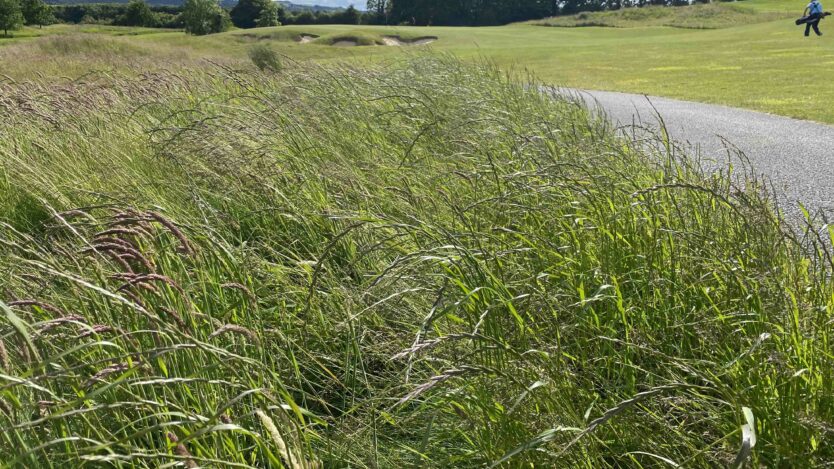
A rough time for courses?

Wet and warm weather – it’s perfect for grass growing. And our greenkeeping teams have been right up against it over the past few weeks in one particular part of the course

You mow it on Monday and it’s back by Friday! What do you get when you mix wet weather with warm temperatures?

An explosion of grass. If you’ve checked out any road verges over the last few weeks, you’ll have noticed that once carefully manicured kerb suddenly went waist high.

It’s no different on a golf course. Our grass plants love warm soil temperatures, revelling in the moist, humid, conditions and they start reaching for the sky like they’ve sprouted wings.

A golf course is not a road kerb. It’s a massive site measuring, in some cases, hundreds of acres.

We want tees, fairways, and greens to look as good as possible and greenkeeping teams must prioritise those areas.

But we’re also not very good at keeping our balls on the short stuff and that means we can often find ourselves in rough during a growth spurt.

So what sort of challenges does managing the rough provide when growing conditions are at their most favourable? How much time do greenkeepers spend cutting it back, how does that time impact the rest of the course, and should we be more tolerant when our ball is buried off the beaten track?

We asked two course managers to give us the lowdown about how they manage the thick stuff and the effect it has on their day-to-day job.
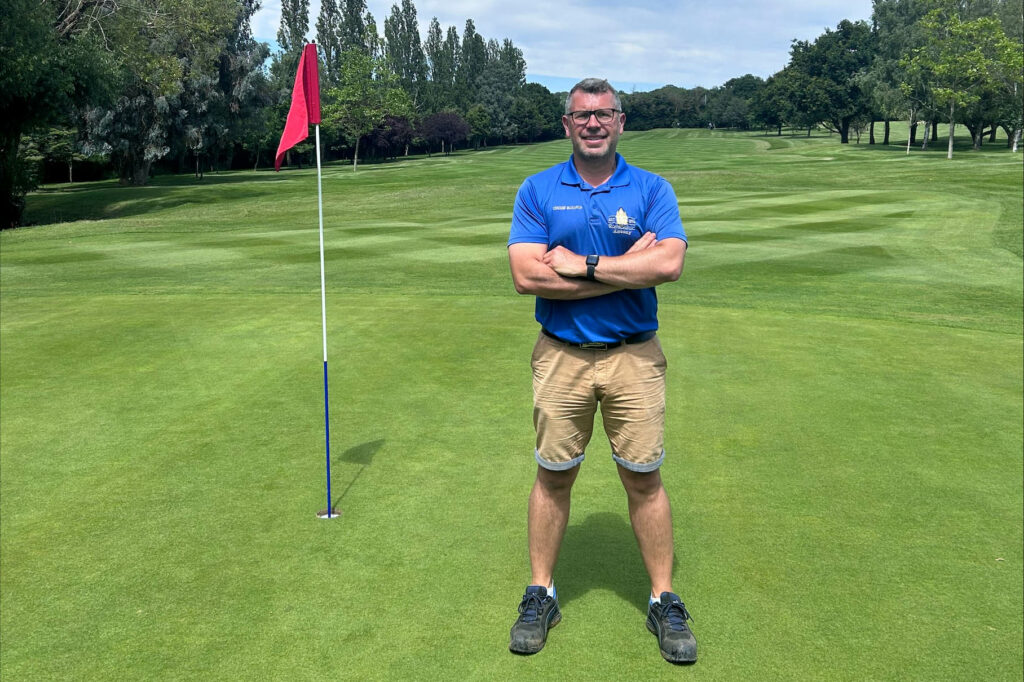
“By Friday, you wouldn’t have known it had been cut”

Antony Kirwan is course manager at Romford, in Essex

“It takes us 33-man hours to cut our rough – wall to wall,” Kirwan says. “That’s realistically five days, given that guy doesn’t sit on that machine from Monday to Friday.

“He’ll help rake bunkers. He may do set-up. Rough is down the pecking order a little bit. You start at your green and you work your way out. I mean, you’re not going to miss a greens mow so you can get some rough cut.”

You won’t believe how quickly it grows back at Romford.

Kirwan adds: “What [rough] you cut on a Monday, by Friday you wouldn’t have known it had been cut – especially during May.

“This has been the best growing spring I’ve known for quite some years. Obviously, we’ve had a lot of rainfall. February was above average temperatures. March was the same.

“There was no frost in April. That’s the first time that’s happened since I’ve been keeping data. I’ve been in the game 34 years and I really could count on my hand how many times I’ve been through April without frost.”

Sometimes, whether it’s staff numbers, holidays, or circumstances – perhaps a competition is being held – there are also other priorities a course manager must consider first.

“[At this time of year] everything needs to be cut – not just the rough – and there’s no way I’m not going to cut the fairways or they would be poor. We were cutting them three times a week during May and we’re still cutting twice and three times a week now.

“We don’t cut the rough that high, either. We cut at two- and three-quarter inches but it can be quite dense in areas and the ball can disappear.”

Kirwan estimates rough probably makes up about 40 per cent of their 96-acre site at Romford. The choice for his team of seven can come down to manpower. Have they got enough people to make sure the main playing areas are presented as members would expect?

“Everyone plays off the tee. Everyone putts on the green. If you start missing those areas out, members will soon pick up on that and be more critical than the odd bit of rough where one person has gone in a square metre that, unfortunately, has not been cut,” he says.

“But it’s just growing so quickly and they are low traffic areas. If you get a high wear traffic area – people predominantly walk up the fairway and off the tee – they will stay short.

“But rough is a low traffic, high maintenance area where, if you haven’t got the manpower and if you haven’t got the right machine for the job, it can be extremely difficult.”
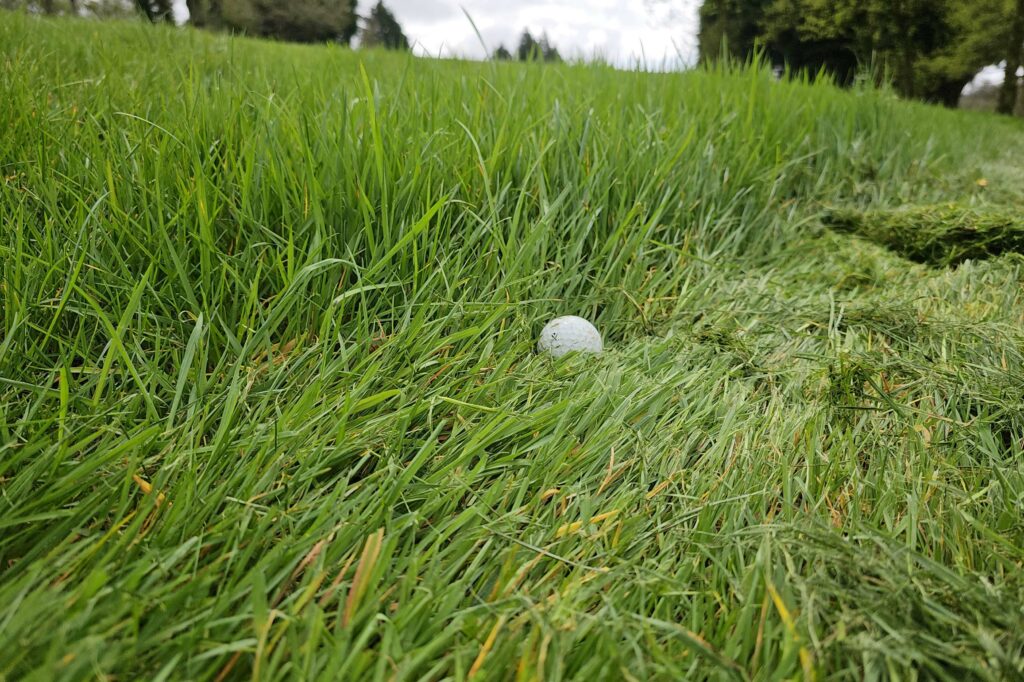
“We talk here about the grass growing behind you”

Lucy Sellick is course manager at Wenvoe Castle, near Cardiff

It’s torrential rain followed by 20 degrees. They had 1.6 metres of rain at Wenvoe Castle last year and the first quarter of 2024 followed up with 650mm.

For Lucy Sellick, the combination means “humidity goes off the charts”. And, yes, that means a lot more rough.

“Growth potential is probably at its maximum,” she explains. “There are warmer temperatures, soil temperatures have increased, it’s moist and it just means it grows and grows and grows.

“We talk here about the grass growing behind you. That’s where we are at the moment. Every machine is flat out and just when you think you’ve got it down, you’ve got to go back around and start again.”

Sellick has a team of four at Wenvoe Castle but was running with three over a chunk of spring. With one rough mower in use, dealing with what the weather brings is a significant drain on time.

“It will be one of the team on the [rough] mower probably for three days straight. He’s on it Wednesday, Thursday and Friday.

“When you’re cutting on a Wednesday, you’re cutting up 50mm. But then that bit doesn’t get cut again until the following Wednesday and it’s closer to 75mm or 100mm. It can be double the height of grass in that time.

“That’s pretty much every week – even to the point where we’ll see some areas that are thicker than others and so I might even send them over on a Monday, just to try and get those landing zones and stop the complaints of members losing golf balls.”

Strimming, bunker weeding, and other small projects are dropped as attention centres squarely on cutting and making sure playing surfaces are up to scratch.

“A lot of members or golfers might not realise greens are cut daily,” Sellick explains. “That’s a three-hour task. We like to do tees three times a week. They are three-hour tasks. We cut aprons two or three times a week.

“Fairways are twice a week – and then picking up any of the long ones a third time – so they take a day-and a bit to cut. You’re talking three days just cutting fairways.”

Add in the rough too and it takes full focus. But delving into the deep stuff is not only time consuming.

“It’s thick and lush and soft and it almost grabs the ball,” Sellick explains. “And on top of the long grass, you’ve also get the debris. So you might have cut it today, but that would have left a lot of grass clippings around because rough mowers don’t collect them.

“So you might be looking for your golf ball in the grass and you might be looking for it under a lump of debris.

“We’re lucky. We’ve got a tractor mounted blower so I can send someone out behind the rough mower and just distribute those grass clippings. But then you need the manpower to do that as well.

“So that’s the kind of extreme measures we’re taking at the moment.”

By GCMA Content Team

More from Your Development

Close

Allister Frost


A former Microsoft Digital Strategy leader who now inspires audiences to discover the life-enhancing benefits of having a Future Ready Mindset. As a tech pioneer, Allister gained unique insights into how to transform uncertainty into opportunity, and now loves giving others the positive mindset and simple habits needed to:

  • Stay resilient in the face of uncertainty and change
  • Spot quick win opportunities for improvement
  • And *create* a brilliant future!


With AI and robots coming for our jobs (hint from Allister: they won’t, if we know how…), many people are anxious about the future. But Allister asserts that we’ve nothing to fear when we leverage our human superpowers and ingenuity to thrive alongside emerging technologies. That’s why having a Future Ready Mindset is now a must-have skill to remain competitive and relevant to the people we serve, our golf club members and the local community. And the best bit: everyone can do it!

This will close in 0 seconds

John Steele


John Steele is a former professional athlete, sports coach, Olympic Leader and is the Executive Director of Sport at Loughborough University. He has been Chief Executive across a range of sectors. Drawing on leadership experience of nine different Olympic and Paralympic Games (including the amazing events at the Rio Games), John reflects on the lessons from this unique period in British sport and relays his fascinating views on creating high performing teams.

Indeed, inspired from PyeongChang 2018 Olympic Winter Games, by the most successful performance ever for Team GB, he has a whole host of new business and leadership insights into how this was brilliant performance was achieved and how it can translate back into your organisation.

John moved into the corporate world, before he enjoyed an outstanding career as a professional rugby player achieving international honours. After his playing career, he turned his hand to coaching and achieved the highest accolade for a British club coach by winning the European Cup with Northampton Saints. He then became Executive Director on the Saints Board during a period of unprecedented growth, and served on the England Rugby Board during the successful world cup campaign of 2003. It was no surprise that John’s talents were called upon to drive through a change and modernisation programme as CEO of the Rugby Football Union – a challenge that became controversial and ended in his departure from the post after only a year, but with his dignity and professional pride intact.

Headhunted by UK Sport, John took up post as CEO the day before London won the 2012 Olympic bid – and this promising start was sustained as he embarked on developing the UK’s high performance sport system, which he led for a six-year period of unprecedented success through the Beijing and London Olympic and Paralympic Games.

Post-London 2012, with the Olympic legacy in place and an obligation to continue inspiring a generation, John took up his post as Group Chief Executive of the Youth Sport Trust. He has also succeeded Steve Cram as Chairman of the English Institute of Sport, an organisation described as ‘the team behind the team’, which delivers a range of performance impacting solutions to over 40 Olympic and Paralympic sports and some non-Olympic sports.

This will close in 0 seconds

Dr Jo Salter MBE


Dr Jo Salter MBE is famed for becoming the first female fast jet pilot, having flown the Panavia Tornado ground attack aircraft during her services in the Royal Air Force. Joining the RAF aged 18, Jo has since taken Air Cadets into the skies as part of Air Experience Flights, become the Director of Global Transformative Leadership for PWC, and most recently become a Global Advisory of GenAI for PwC.

Jo has piloted flights in the Air Cadets Air Experience Flights and inspired countless budding armed service members to pioneer a male-dominated sector, having been the leader of an all-male squadron. Since leaving the military behind, Jo has established a strong business career working in roles such as Head of Technical Services for NetConnect, European Operations Manager for Automated Power Exchange and Managing Director of Saltin Ltd.

Having developed first-class expertise in leadership, analytical thinking and performing under pressure, Jo is now a highly sought-after public speaker to share stories from her time in the skies.

Jo is a passionate Trustee of The Royal Air Force Club and an Ambassador of the Global Angels charity, an organisation that gives communities around the world access to clean water, education, healthcare and encourages female and youth empowerment. Jo has also authored two books, titled Energy: 52 Ways to Fire Up Your Life and Become an Energy Angel and Energize: Spring Clean Your Mind and Body to Get Your Bounce Back Today and Every Day.

In recognition of her achievements throughout her career, Jo has also been named as one of the 50 Most Inspiring Women in the World by Harpers & Queen. She is now working as the Director of Global Transformation Leadership at PWC, after working in other roles such as Director of Risk Technology Strategy, Director Chief of Staff to Head of Technology & Investments and the Director of People & Organisations.

In 2022, Jo was invited personally by Tom Cruise to attend the premiere of Top Gun: Maverick. Most recently, Jo received an honorary doctorate of Arts from Bournemouth University.

This will close in 0 seconds

Colin MacLachlan


Colin Maclachlan, star of Channel Four's captivating reality TV drama SAS: Who Dares Wins and Channel 5’s ‘Secrets of the SAS’, is an operator with over 25 years of security and risk related experience who is a popular and frequent fixture on the speaking circuit.

Colin Maclachlan, celebrated for his roles on Channel Four's SAS: Who Dares Wins and Channel 5’s Secrets of the SAS, brings over three decades of expertise in security and risk management. Colin's military career began in 1989, and after serving nine years with the Royal Scots, he joined the elite 22 SAS at just 23. His time in the SAS saw him participating in numerous high-stakes operations, including the notable rescue of hostages from the West Side Boys in Sierra Leone—a mission so perilous it was dubbed Operation Certain Death.

Colin was also pivotal during the longest hostage siege on UK soil, when a hijacked Afghan plane landed in London in 2000. The standoff lasted four days with Colin as the first sniper on the scene.

After leaving the SAS, Colin exchanged insights with international forces such as Delta Force and Seal Team 6 and provided security consultancy to the Saudi Royal Family and various celebrities. His academic pursuits led him to earn a First Class MA (Hons.) in History from Edinburgh University and an M.Litt in Terrorism from St. Andrews University.

Today, Colin extends his expertise through television, books, radio, and video games. He supports numerous charities and has founded Who Dares Cares, which assists veterans and those experiencing stress. As a speaker, Colin excels in discussing Resilience, Teamwork and Leadership.

This will close in 0 seconds