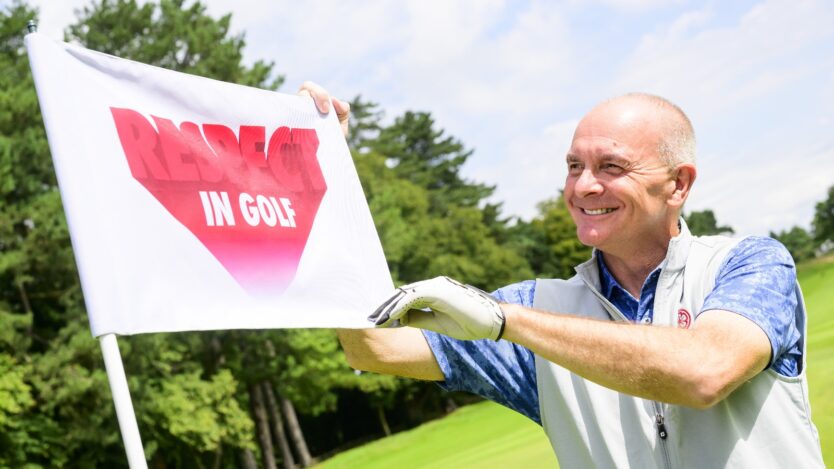
England Golf’s flagship campaign aims to make the sport a welcoming environment for all players. But what is it? The governing body’s chief executive Jeremy Tomlinson reveals all
This article is part of GCMA Insights – topical content for golf industry professionals, discussing the things that matter to those who work in golf clubs.
Everyone should have the same opportunities to play golf. Sounds simple, doesn’t it? But it’s a sentence our sport has struggled with throughout its history.
Plenty of progress has been made. There remains work to do. And through Respect in Golf, a campaign launched last year by England Golf, the ante has been upped.
As a mandatory term of affiliation, every golf club in the country has to agree to a series of commitments – confirming them as a venue open to all, regardless of colour, creed, gender or sexual orientation.
But what are its aims? How is it being administered? And what issues remain within golf in England?
We sat down with Jeremy Tomlinson, the governing body’s chief executive, to talk about the flagship policy…
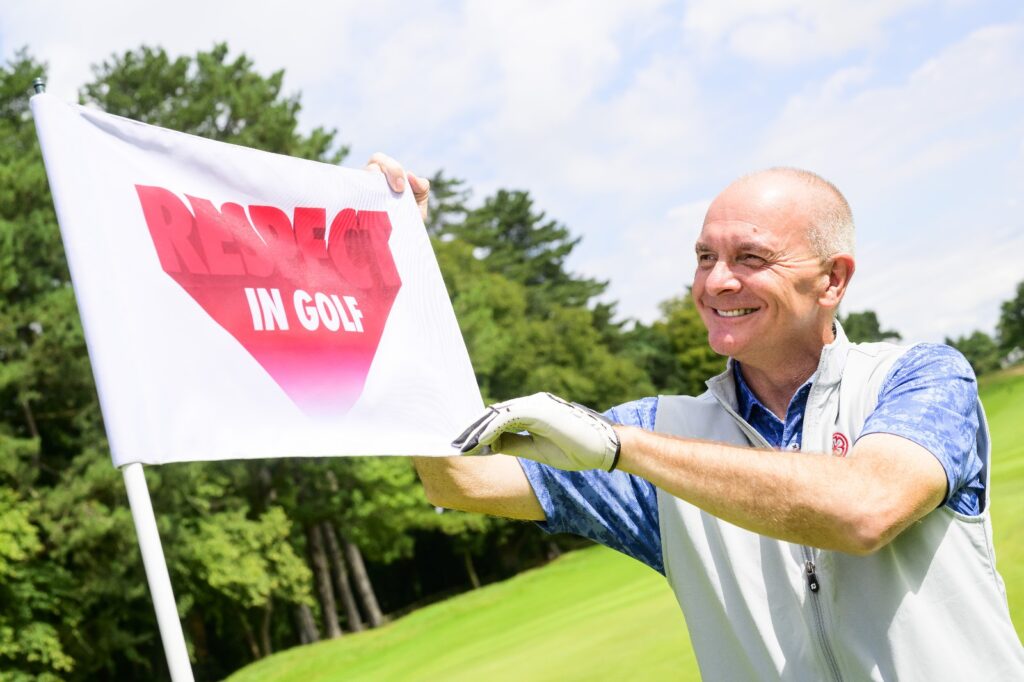
What is Respect in Golf?
The common theme that must be the lifeblood throughout England Golf is inclusivity.
If you want to make your sport, or anything, more inclusive, what must you make sure happens? A simple word came out. Respect.
If everybody can respect each other, it means people treat each other with more care, and it means the sport truly can be more inclusive.
There is no place in golf for any form of discrimination. We must take care of people on the golf journey, at whatever level they want to play at, and we must respect that.
No matter anybody’s age, their gender, their ethnicity, their sexual orientation – it doesn’t matter. We want them to feel welcomed into our sport, to have an equal opportunity to enjoy themselves, and to be table to take their skill set or desire wherever they want.
Get involved in the debate.
To join the GCMA, click here, or to organise a call with a member of the GCMA team, just complete the form below.
The launch came with some headline grabbing survey results: a third of golfers had either witnessed or experienced discrimination and 71% had not reported it. That was an alarming figure…
Golf is not perfect. Like any sport, it’s a work in progress and when you get that many people playing it – some 8.5 million people in England – it is reflection on society and community.
We’re not shying away from those figures. As much as they are startling in some respects, they are also not surprising in others – because they do happen in all walks of life.
For me, it’s less about pointing to those stats and saying, ‘aren’t they horrendous?’ It’s more a question of saying, ‘they are what they are. This is where we’re at. Let’s set about trying to get our sport into a better place’.

The Respect in Golf website reiterates much of what you have said. But golf clubs are their own businesses and have their own identity. How are you working with them to ensure these ideals? What is the process?
We have total respect for the 1,765 golf clubs. They are their own business entities, their own membership organisations, and we’re not here to dictate.
We are here to help advise a best course of practice and we do have four very simple terms of affiliation.
We have a safeguarding policy, an anti-doping policy, an ED&I policy and process, and a disciplinary policy and process. Every golf club in the land must adhere to them.
They are mandatory terms of affiliation. There are lots of clubs out there doing really good work. But there are clubs that just need help with regards to a framework. Those simple terms of affiliation help that.
The ED&I policy and process very much includes a Respect in Golf accreditation.
We’re getting close to 700 clubs accredited and we have another 800 working towards that.
Rather like safeguarding, where every club in the land became accredited because they felt it was a priority, we know we will get there again – where every club will hold up their hand say it is really important and a priority to have an equality, diversity and inclusion process and policy.
The mechanism to shout about it will be through Respect in Golf.
There was a carrot and a stick with safeguarding. There was the threat of disciplinary action for those who, for whatever reason, didn’t complete the accreditation. Will it be similar here?
The last thing we want to be doing is wielding any stick. That is not what we’re about. We’re not dictators, but we are here to support and advise and cajole and, hopefully, inspire on many different matters.
But there is a reality. We have a responsibility to try to make sure golf is always promoted and portrayed and lives the best way it possibly can.
It feels like a complete no-brainer as to why a club would be SafeGolf Accredited or why a golf club would be Respect in Golf accredited and have an ED&I policy.
It’s just the right thing to do.

It’s very easy to say the right things and quite another to do them. How will clubs be monitored to ensure they’re keeping the commitments they’ve signed up to having gone through the Respect in Golf process?
Every year there is an accreditation that must be renewed. We learned a lot from the SafeGolf Accreditation so we know we can administer that.
A lot of good work has been done by our counties who are all Respect in Golf accredited. They work with clubs trying to make sure the right things are being processed.
Our Club Support Officers support those clubs. But, ultimately, it is like the game itself. There is an integrity level.
There has to be an integrity at every single golf club that signs up to Respect in Golf – that is they truly want to carry through the policy and processes they’re signing up to.
We can come in and we can speak to them, we can cajole, we can call them out on things. But there must be a level of integrity and a pride every golf club must take in itself.
WHY JOIN THE GCMA?
Membership of the GCMA unlocks a network of like-minded professionals, provides you with support in your professional and personal development, and provides you with a multitude of benefits. Whether that’s the tools that will help you to excel in your profession, or a wide range of services to support your wellbeing, signing up to the GCMA is joining a community.
What does ED&I look like to England Golf? Is it equal access?
It’s summed up by saying, ‘is there equality of opportunity?’ Is there equality of opportunity with regards to membership?
If so then, within that membership, is there equal opportunity with regards to playing or voting rights? It really comes down to that. The best clubs look at themselves in the mirror and start there.
There are not nearly enough female members of golf clubs. It’s something like 14 per cent of the 722,000. It is over 100,000 women, which is a really healthy number compared with historically. But compared to the male number, it’s very small.
It would be wonderful to say membership was 50-50 but utopia doesn’t always occur. One thing I know is 14 per cent is not enough.
That 14 per cent is reflective of some golf club cultures. I think we’ve made headway but we need to do a lot more.
As I compare us to many other sports, that have clubs at grassroots levels, we must continually look at ourselves in the mirror. I urge every golf club, every committee, to do that.
We work hand in hand with the Golf Club Managers’ Association, with Tom Brooke and his team, who are brilliant. We’re working with them to get all general managers – with ourselves – to look in the mirror and ask, ‘how can we make golf a better place? How can we create that equality of opportunity in every golf club up and down the land?’
Is it a generational thing? It would be easy to assume as they move on, these attitudes will shift but, presumably, you don’t want to wait?
We have complete respect for all generations.
But there is a culture, a tradition, and it may be a little bit more prevalent at members’ clubs. You have committees or boards that are there to represent and so you have more people looking to make decisions for the membership.
Sometimes that takes a bit longer than perhaps a proprietary owned golf club, where you might have a more commercially minded person sat at the top of the tree who owns and wants a return on their investment or their money.
I am respectful of process. I’m respectful of memberships and of membership organisations.
But I also need to be there and look to cajole, to push, to call out sometimes, some different clubs who are not doing enough.
The seven worst words in life are ‘it’s the way we’ve always done it’. We’re all bored of that. That is a laziness with regards to tradition and culture.
There is nothing that means golf must be confined or restricted to a culture that does not have equal opportunity within it. That just doesn’t sit well with me at all. That’s rubbish.
We’re a sport steeped in heritage and we have the ability to mould what traditions and cultures look like for the future. They should be filled with equal opportunity.
Sometimes it just takes peers to do it. One club down the road will do it. and then a club looks over and goes, ‘gosh, what are they doing? Wow, they’re progressive. We should be doing that’.
I don’t expect this to happen all at once. I’m not naïve on that front but [we must do] anything and everything we can to expediate this.
Could the Equality Act be more helpful? The message you’re promoting would be easier if it didn’t make a distinction between, say, private associations and the workplace…
Yes, perhaps it could. But I also think that within the Act, there’s enough there that everybody could take certain parts and say, ‘are we doing that?’
It’s back to looking in the mirror.
I don’t like quoting the law. The law is a fairly low bench. The law has to be adhered to – period – in anything and everything. What we’re more interested in is: what is the right thing to do for the promotion of our sport?
What is the right thing to do to drive our sport in the right direction to make sure it’s not only the in the best possible shape for all for all golfers right now, but for all golfers to come in future generations?

Let’s talk about working women, who may not be able to play in a traditional ‘Ladies Day’ and then find weekend golf can be restricted in a way that perhaps it would not be for a man. This is where equality of access really comes into clear view, doesn’t it?
It does. Let’s face it, whether you’re male or female, a 7-day membership is referred to as that but it’s also very affectionately referred to as a two-day membership for so many people – because they’re working hard through the week.
We spoke about the cost-of-living crisis. It’s very real. Everybody goes out and earns a living. So to have a situation where you have a membership where people are paying the same amount, but there is a differentiation between the rights of certain elements, is antiquated.
It is something that every golf club in the land should be looking at themselves – again looking in the mirror – and asking ‘is there an equality of access? If somebody is paying the same amount to be a member of my club, they are a member of the golf club’.
So they should be able to utilise it in the same way – and certainly with regards to gaining access to tee times and playing rights.
The campaign has four key pillars: lead by example, energise and support with better understanding, deliver a safe environment and inspire the most welcoming environment. How did these evolve?
These stem from our values. They are our core values. They are our reason for being. The first three are epitomised by the last one to inspire current and future generations.
That’s what it’s all about. If we get the first three right. If we are able to lead with strength, to support with strength, and be able to advise and promote the game in the best possible way, then it really wraps those values up.
There’s a video on your website that sums up the campaign’s aims. How are you pushing it forward into year two, three, and four?
It’s about the love of the game. I think sometimes golfers may forget how important the game is to golfers. Sometimes you need to be inspired by people who turn round and give you heart rending stories.
Non-golfers don’t see that a lot of the time because golf is too good at talking to golf. What we need to do is make sure people from outside the game can see actually it is a sport for all.
The numbers depict that. It’s just sometimes people have this age-old antiquated perception that golfers are stuffy old guys and that’s all it is about – as opposed to this fun sport than anybody and everybody can touch in any way they want.
With regards to Respect in Golf, you’re going to see each quarter we have a plan laid out – certainly to the end of this year, and then we’ll plan what 2025 looks like.
This will be the lifeblood of the whole time I’m heading up the organisation. This is a lifeblood with regards to driving anything and everything that England Golf does, that our counties do and through our golf clubs as well.
We hope to inspire, and we are inspiring lots of other organisations and other sports to come together and hold hands with us with regards to this whole ethos of Respect in Golf and respect in sport.
“That’s our remit, that’s our responsibility, and that’s what we’re aiming to do.”
This article is part of GCMA Insights – topical content for golf industry professionals, discussing the things that matter to those who work in golf clubs.
Enquiries
"*" indicates required fields