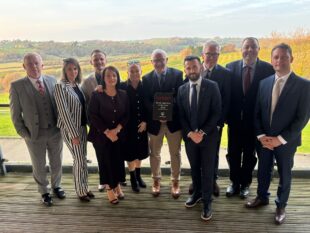
The latest episode of GCMA Insights on Golf Talk UK focuses on one of the most important topics in the industry: people, recruitment, and the welfare of employees at golf clubs.
The golf industry is facing a critical challenge: finding, recruiting, and retaining top talent.
That is the focus of the latest GCMA Insights podcast featuring Dave Reeves and Matt Orwin of Promote People, along with our own CEO Tom Brooke, as the trio unpack the complex landscape of workforce management in golf clubs with host Leighton Walker.
The discussion explores both sides of the recruitment coin: how golf clubs can attract and keep the right talent, and how managers and aspiring leaders can find roles that truly fit their skills and ambitions.
Recent research from Sporting Insights reveals a stark reality: 42% of golf clubs identify staff retention as their biggest challenge. This statistic underscores the urgent need for strategic approaches to people management.
Brooke set the scene with some telling data from GCMA’s Workforce Study with Sporting Insights.
“Among the biggest challenges for golf clubs and golf club managers is staff retention — 42 per cent said that is the biggest challenge for them in their golf club,” he said.
“We have to look at trying to find solutions and help golf club managers in being able to recruit and retain really good people if we’re going to continue to run golf clubs in the fantastic way that many of them are being run at the moment.”
For Reeves and Orwin, who founded Promote People after long careers in club management, the recruitment process itself often determines how successful the relationship will be. As Orwin explained, clarity is everything.
“It’s about a clarity of purpose from the golf club as well as from the manager,” he said. “You probably go to quite a few clubs that don’t have that clarity — they don’t have clear, strategic goals the manager can buy into. And maybe there’s an argument that if the club doesn’t have that vision, the manager needs to help create it.”
He added that interviews should be a two-way process, saying: “The person who’s going for that job needs to see it as an opportunity for them to interview the committee as much as the committee are interviewing them. If you’re not asking as many questions as they’ve asked you, you’ve not really got under the skin of what that golf club’s about.”
Reeves agreed that mismatched expectations are a frequent cause of short tenures.
“It’s so important for us to ask the right questions of the hiring committee,” he said. “It’d be a disaster if you had a committee-led club passionate about their five-year plan and we placed someone who wants to drive their own vision. You’re going to get a clash from day one.”
Recruitment recommendations
- Develop a 12-month recruitment plan
- Conduct anonymous staff surveys
- Offer competitive compensation
- Create clear career pathways
- Foster a supportive work culture
Once in post, relationship-building becomes vital. Reeves explained: “Whenever there’s a change within that club, it’s really important for the GM to get buy-in from all the stakeholders — go out for a game of golf with new committee members, establish those relationships, ask what their expectations are. It’s a two-way thing.”
The conversation also turned to work-life balance, an increasingly important factor for attracting and keeping good people. Brooke noted the shift in mindset since Covid-19.
“We’re in a challenging market now of how we can create roles that provide good work-life balance and some level of flexibility,” he said. “We really need to think creatively about how we do that.”
He said the research identified three key things staff value most: “Clear purpose, wellbeing, and work-life balance. That doesn’t all have to be about flexible working — it might just be about respecting that work starts and finishes at certain times and that it’s not reasonable to phone the manager at two o’clock on a Sunday afternoon.”
For those aiming to progress their careers, Reeves advised being strategic and self-aware.
“Work it back. If you have aspirations, know your dream job and plan the steps you need to take to get there,” he said. “Identify your skill gaps and fill them through mentoring, education or experience.”
On the club side, Orwin stressed that recruitment should be proactive, not reactive.
“It’s about having a proper recruitment plan,” he said. “We still see clubs advertising for seasonal staff in February and wondering why, by the first sunny weekend in April, they’ve got no one in place. Have a rolling 12-month plan and move quickly — it’s an employee’s market.”
For a deeper dive into these insights, listen to the full GCMA Insights podcast and discover how to transform your club’s approach to people management.
Key Takeaways
- Define the purpose. Clubs must be clear on whether they want a strategic leader or an operational manager — and communicate that from the outset.
- Build the relationship. Mutual understanding and early engagement with committees are critical for long, successful tenures.
- Plan ahead. Both individuals and clubs should think strategically — whether that means mapping a personal career pathway or maintaining a year-round recruitment plan.