Over the past three years, Piltdown Golf Club has transformed long held principles into meaningful action surrounding Women’s golf, leading to a nomination for the Women in Golf Charter Award at the England Golf Awards.
Case study provided by Piltdown Golf Club
Why we did this
Like many golf clubs, Piltdown was facing a familiar challenge. Our female membership was ageing, and despite having an Academy in place, we were not seeing enough new women coming into the game. In Winter 2022, when we signed up to the Women in Golf Charter, we committed to doing something proactive about it.
Our original goal was modest: to introduce eight new women to golf. Three years on, we have introduced 106 women, grown our Academy from 20 to 77 members, and built a strong pathway into full membership. Along the way, we have learned a great deal about what helps women and girls feel welcome, confident and motivated to stay in the game.
| Commitment | Current Situation | How this will be achieved | Date/Progress/Targets/Comments | |
| 2 | Encourage more women to take up golf | The Academy is an attractive package, but can be seen as too much of a financial commitment and intimidating for a golfer on her own | A Winter Foundation Course for a group of 8 women. Fortnightly clinics + 5 range tokens a week (100 balls) + use of all practice facilities + use of the clubhouse + support of the ladies’ section + a guaranteed place in the Academy for £100 | 8 members in the first instance |
Understanding the Barriers
We already offered a good Academy package, but it wasn’t working as an entry point for beginners. Two things quickly became clear.
First, the cost and commitment were too high for someone who had never played before. £450 a year felt like a leap of faith. Second, many women felt like they didn’t belong in the world of golf. Golf clubs can be intimidating places if you don’t already know the rules, the culture, or other members.
What we were seeing matched what the golf press and participation research have been saying for some time: women often have less time, less spare income and are more likely to value social support than traditional, individual pathways into golf.
Getting the whole club on board
Nothing we have achieved would have been possible without buy-in from across the club. Our Board supported the idea that growing women’s golf was a strategic priority. Our Head Professional committed time in a busy diary to coach complete beginners in groups. Our Club Secretary helped design the programme, the office team took on the marketing and administration and our ladies’ section offered their time and energy to mentor the Foundation members.
That shared commitment sent an important message: this wasn’t a side project for the ladies’ section, it was a club-wide initiative.
The Foundation Course: lowering the threshold
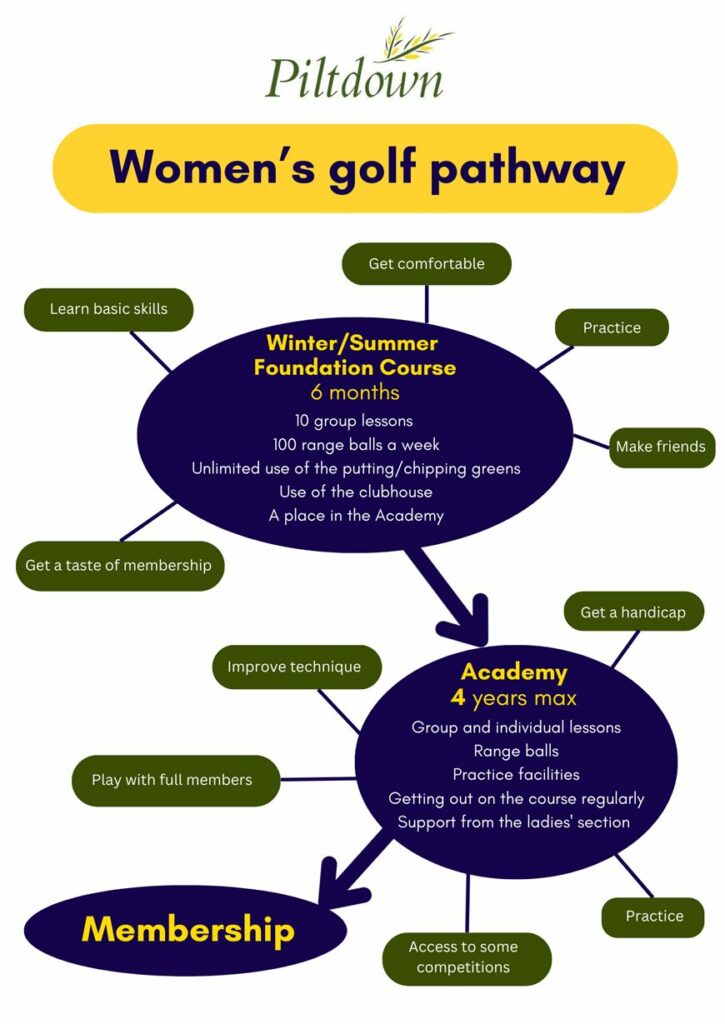
The key intervention was the creation of a new entry route, which we called the Foundation Course. The principle was simple: make it affordable, sociable and unintimidating.
For £100, participants received:
- Ten group lessons, held fortnightly on Saturday mornings
- Five range tokens a week (100 balls)
- Unlimited use of the putting and chipping areas
- Use of the clubhouse
- All equipment provided
- A guaranteed place in the Academy on completion
Group lessons were a deliberate choice. Learning together created instant friendships and a sense of shared progress, which proved far more powerful than individual coaching alone.
Recruitment: keeping it simple
We didn’t start with social media campaigns or external advertising. Instead, we asked our members for help. A single email went out inviting them to tell their daughters, sisters, friends and neighbours about the course.
The response exceeded expectations. We had 11 women in the first course almost immediately. In 2023, 35 took part. In 2024, 36. In 2025, 24. Our next course starting in March 2026 has 12 participants. We have never had to actively promote the course since that first email: word of mouth has done the rest.
Women who contacted the club directly to ask how to start golf were also offered the Foundation Course, giving us a clear and welcoming answer to a question many clubs struggle with.
To date, 106 women have completed the Foundation course. Of those, 77 are now in the Academy, with two joining as full members before even finishing their Academy journey.
From the range to the course
One early lesson was that practice confidence does not automatically translate into course confidence. Although Academy members had playing rights, very few used them. Feedback was consistent: the course still felt intimidating.
We had set up a WhatsApp group to help them organise games, but we realised that we needed to do more. We introduced a buddy system, where full members booked regular tee times that Academy players could simply join. These were clearly listed on the Academy page of the website, making access easy and transparent.
We also introduced Academy scrambles on Sunday afternoons, pairing Academy members with experienced players. These events were hugely popular. In September, 21 Academy members played alongside seven full members; in November, 22 Academy members were supported by six full members. Both groups enjoyed the experience, and regular scrambles are now part of our calendar.
Making the club more welcoming
As more women came through the Academy, it became clear that traditional club culture could still feel daunting. Many had never belonged to a sports club before.
In response, we relaxed the bar dress code, introduced informal social events and created spaces where asking questions was actively encouraged. Small changes made a big difference.
We also reviewed the Academy structure itself. Women were using lessons and practice facilities far more than expected and playing fewer rounds. Rather than seeing this as a problem, we adapted the programme. Lesson allowances and range tokens were increased, playing entitlements adjusted, and the joining fee waived for women completing the full Foundation and Academy pathway.
This winter, we introduced a Winter League open to both Academy and full members. Eleven Academy members and 33 full members signed up, helping integration through friendly competition. This has also prompted Academy members to put cards in to acquire a handicap.
Where we are now and what’s next
Our aim is to convert around 10–12 women into full membership over five years. We already have two. Just as importantly, we now have a sustainable pipeline and a clear, welcoming pathway into the club.
We continue to collect feedback and adapt. One adaptation was to add two two-hour clinics to bridge the gap between the end of the Foundation course and the start of the Academy year. We did this when we realised that the majority of Foundation members went to join the Academy. We had to increase the price to £150, which we felt was still an affordable price point. With many Academy members being younger and working, we are also looking at moving some trophy competitions to weekends to better reflect modern lifestyles.
Extending the model to girls’ golf
Having seen what was possible with adult women, we turned our attention to girls. At the end of 2024, we had 24 girls, three with handicaps. It was a good base, but we believed we could do more, so we removed waiting list barriers, introduced a girls-only weekly coaching group, and installed a rated 3,574-yard orange course so younger players could submit cards.
One year later, we have 29 girls (a 20% increase) and 32 qualifying scores have been returned. The number of girls with handicaps has risen from three to ten, a 233% increase. For context, there are only 73 girls with handicaps across the whole of Sussex.
To support progression, we moved two ladies’ trophies into school holidays and, for the first time in over ten years, entered a team in the Sussex County Division 1 Championship. Our lowest-handicap girl now plays off 1.5 and represents Sussex.
Final thoughts
Our experience at Piltdown shows that there are lots of women out there who are interested in golf, and that growing women’s and girls’ golf is not about one-off initiatives or heavy marketing. It is about understanding barriers, designing pathways that reflect real lives, and being willing to adapt club culture.
The results speak for themselves, and we hope other clubs can take ideas, confidence and practical tools from our journey.
By Mark Shanley