 Golf’s oldest major will return to Northern Ireland, and Royal Portrush, for the first time since 1951 next year. Long-serving secretary manager Wilma Erskine talked to Mike Hyde about what it takes to host The Open
Talk me through the process of getting the Open?
It was very much a dream. Peter Dawson (former chief executive of The R&A) came here several times. We knew Martin Ebert was the preferred architect for The R&A so when we all got together, we thought where would we start and where would we finish.
We know there is a large tented village at The Open, and there are a lot of stands, so it was about getting the infrastructure right. The way the course was then laid out, the 18th was right beside the 1st. It wasn’t going to work for the large grandstand.
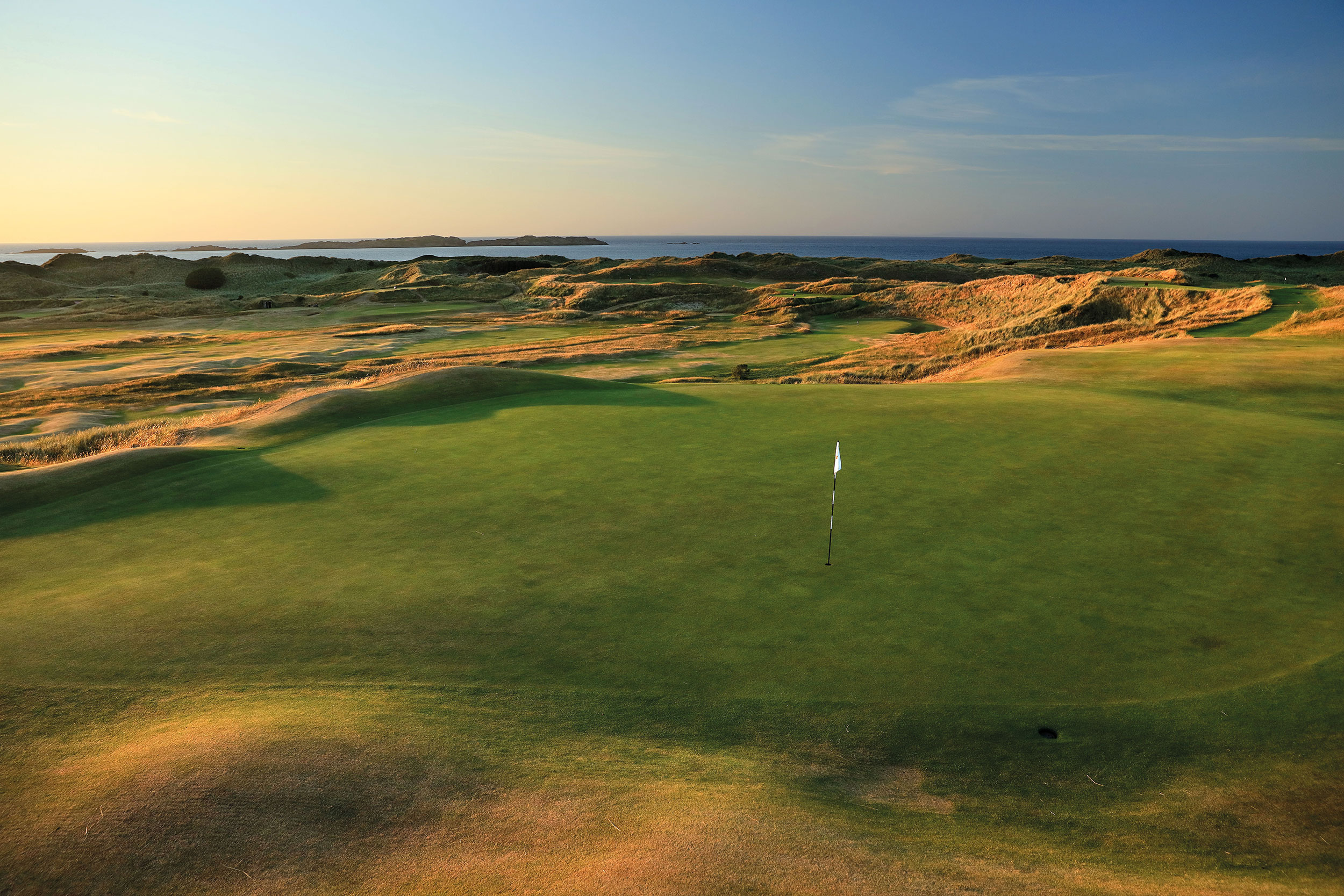
One horrible wet miserable day, Peter Dawson and Martin Ebert went out again and had a look and it was a eureka moment – ‘what about making two new holes and doing away with the old 17th and 18th?’ They were deemed, by journalists and the golfing fraternity, as being the two weak holes. We thought about it and it was all a bit of a shock but, once the plans came together, it seemed quite an obvious thing to do. They took two holes – the old 5th and 6th of the Valley Course – and created the new 7th and 8th (on the Dunluce).
So from a par 4 and 3 on the Valley, they created a par 5 and a par 4. I have to say the new holes have integrated really well. A lot of people are full of praise and they think it is going to make a pretty tough Open Championship course.
When was it first mooted?
It was way back in 2006 when we started a little sub committee. Holding The Open was the final tick on our wishlist. We knew that, in order to convince The R&A, we had to prove we could stage a big event and so we held the Irish Open.
We had negotiations with the governments in both the south of Ireland and the north to negotiate a date. We wanted it sooner than later and George O’Grady, from the European Tour, was very supportive. His family originated from Portrush and he spent many holidays here.
He was very keen to see it return to Northern Ireland and so, as a very last minute thing, we said ‘we can take it in 2012’ – not knowing to what we had agreed.
It was announced on January 6, 2012, that we were having the Irish Open that summer. We had to get all the stakeholders in Northern Ireland together – public transport, accommodation providers, tourism and the road service. Everybody had to come together. There were meetings after meetings to get everything in place for the Irish Open.
The European Tour still say it was the biggest and most successful Irish Open in terms of numbers. They had to stop selling tickets one week before and we had 31,000 on one day.
The R&A had sent some people over to look at the Irish Open – more or less as mystery shoppers – and the park and ride worked very well, the infrastructure worked well as did the accommodation provision. Everything worked really, really well.
Even though we had the most awful weather it was deemed a huge success. So we kept moving along towards The R&A and to The Open.
They saw there was a great willingness. The government were behind us to provide financial support for infrastructure and the rest is history. Now, in 2019, we are hosting The Open.
What was the club’s role in the course design changes?
We were very involved. A contractor came in three years ago and carried out renovations on the Valley course, because we were taking two holes away. So there was a lot of work. We had to make sure the members were still being looked after.
It was quite a challenge to get everything in the right order. But we had a great team here. That included Martin Ebert, First Golf (under Marcus Terry) and our course manager. We had a small sub committee and we all got together and basically worked as one team.
It was important to communicate what was happening.
There were changes to the course and we needed to let the members’ know what was going on and why it was going on. We communicated regularly with them, all through the three-year process of the works, and they found it interesting.
How does hosting The Open affect the members in a practical sense now the countdown is really under way?
The members are in charge of marshalling. The R&A have a chief marshall and it is up to the club to secure 1,200 marshalls for eight days. That’s quite a big task. We record the scoring for all the games as well and we are also involved with the environmental programme, which sees children picking up litter (around the site). That is quite a task in itself because there are hundreds of kids and they have to be organised.
The R&A are very professional and they have their own team but the course is the baby and it’s our staff that do all the work on that. There’s quite a big involvement.
Will you be playing off mats and what are the course closures in the run up to The Open?
As this is the first time The Open has come to Royal Portrush since 1951, our agronomists are very keen that we showcase the course and they are quite right to say that. We are going to go on mats on the Championship course from November.
This is quite an ask from the members. Luckily, we have the Valley and we are not going to go on mats there. As general practice in the winter we use mats for three months every year but we are going to go from November right through The Open. Play stops for the members on June 30.
We want to showcase this not only for Royal Portrush but for the whole of Northern Ireland.
How have you kept the members engaged?
We have used email communication and have had special general meetings where members could ask questions. The R&A have also come to talk to the members. They are going to do a lot more of that in this coming year to allay any fears.
Has it taken over a little bit? Is there a percentage of your time that’s now Open focused?
It’s like having two jobs. There is my job during the day and then there’s The Open.
I have to say it’s really interesting because it could be about anything from agronomy to spectator walkways to tourism, marketing and communications.
There are a little team of us and we sit on different committees. There is always a link with the club to all the various committees. Recently, it was 8.30 in the morning until 3 in the afternoon on The Open and then I started my real work. It’s very exciting. It’s something very different and I can see the light at the end of the tunnel.
How have you prepared personally? Have you spoken to other Open hosts?
Yes, I’ve spoken to Adam Moule at Birkdale and Michael Wells, at Carnoustie, although it is slightly different there because it’s a links trust, and Tim Checketts, at Royal St George’s. We all know each other. But being honest, with having had various championships here and Irish Open along with the way The R&A structure it all, it is all quite easy. It is more they have to control me.
How does The R&A and STRI involvement in the course side of things balance out?
Because we are hosting The Open we’re having quarterly visits. We have Alistair Beggs (STRI chief agronomist) and Richard Windows (STRI agronomy services manager)
who look after The Open venues and they come and inspect every quarter. They will produce a report and they will test for firmness and for various things. It’s very interesting. It’s a great control for the greenkeeper as well. It works both ways. They’re checking on us to make sure we are doing what we should and, for the course manager, he’s making sure he is doing the right things and getting confidence from them.
Does it affect the day-to-day preparation of the course?
No. We had the Boys’ Championship and we used that as a bit of a test. We had championship conditions, back tees and pin positions and we worked with the team from The R&A who do course set up.
Our course manager learned a lot – just about cutting regimes and getting the speed of the greens right.
For tournament conditions, you have to have that speed very consistent. Before the championship we had very odd weather. We had a bit of rain and so it was about getting that consistency.
He had a really good run of producing the greens The R&A are looking for next year. Presumably you’ve experienced more business since it was announced you would hold The Open.
How do you square that with being a members’ club?
That is one of the things that is actually becoming quite difficult. Since we had the announcement of The Open in 2014, our business has taken off. I would say we have doubled our visitor green fees. The committee set the policy for when we can take visitors.
However we’ve now filled those spots. In the past, there was always a space or two. Now it is fully booked and if you wanted a time today I would say it would be 2020 rather than 2019.
One thing that is very important is that the members understand when their times are and the visitors have their times. They are two businesses and the two should never meet. The visitors are very important because they bring in a lot of revenue. The sales in our shop are very driven towards the visitor, along with the bar and the catering.
Our summer season is very busy and I call it a light switch. At the end of October, it goes off and it starts again at the beginning of May.
We’ve already introduced extended tee times from 10 to 12 minutes for visitors. We want to make it an experience for them when they come here. They are paying over £200 so they have got to have a great experience.
We have teams of meeters and greeters so when the bus arrives there is someone from Royal Portrush to meet them, show them the shop, where they can change and explain the clubhouse is theirs for the day. We have a halfway house where they can get refreshments. All these things are costs we bear but we have to make the experience truly enjoyable.
What does The Open mean to the area of Portrush and this whole coast?
The government have invested £15 million into a new train station, a new streetscape and shop front schemes in the town itself.
The town is getting a facelift and it is directly from having The Open. There is more property being built and prices are going up. It’s becoming more desirable. The actual economic benefit being estimated is in the region of £80m to £100m coming into Northern Ireland that week. So everybody can see that this is something quite unique. This is the biggest sporting event coming to Northern Ireland, let alone the island of Ireland.
Wilma Erskine
Wilma Erskine is one of golf club management’s longest serving secretaries, having been at Royal Portrush since the mid 1980s.
Growing up locally, she studied in Edinburgh and the former Bristol Polytechnic before applying successfully for a job at Portadown GC.
She then spent three and a half years at Masserenne before taking the reins at Portrush and plans to step down from the role – following the staging of the Open – at the end of 2019.
Royal Portrush
Royal Portrush was formed in May 1888 as a nine-hole course and was originally known as The County Club. It gained its royal status in 1892, when the Duke of York was the patron, and became The Royal Portrush Golf Club in 1895. The host of numerous top championships throughout its history, The Open came in 1951 when Max Faulkner lifted the Claret Jug.
In 2014, it was announced the famous trophy would return to Northern Ireland and the club, with the help of architect Martin Ebert, went through a renovation programme to the Dunluce Links. Next year’s event is already sold out after around 190,000 tickets were snapped up within weeks of them going on sale.