You might not have the prestige of hosting golf’s biggest team competition, or the budget of Le Golf National, but there’s things that you can apply at your own clubs, as the GCMA’s Young Managers Group found out.
The Ryder Cup probably isn’t coming any time soon to your club. That’s not to say, though, that you can’t apply something from events happening at Le Golf National.
 Everything there is obviously on a huge scale – whether it’s the 450 buggies that will require an electrified car park to charge them all, the 4,000 people a day that will be working on site or the new road that’s being built just for this event.
But in preparing for this three- day golfing jamboree, there are common things Le Golf National are doing, and have done on the journey to hosting this tournament, that can help you and your clubs when staging your own events.
It doesn’t matter if it is simply making an AM-AM that little bit better or improving the monthly medal.
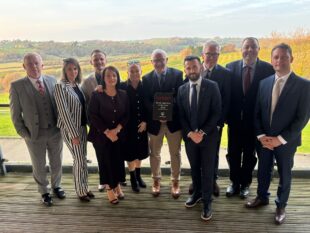
To investigate, nine members of the GCMA’s Young Managers’ Group travelled to Le Golf National during the European Senior Tour’s Paris Legends Championship. Held exactly a year out from the Ryder Cup, the team were given a glimpse into what goes on behind the scenes of a major tour tournament and discussed with general manager Paul Armitage and his team how they are preparing to stage the biggest event in world golf.
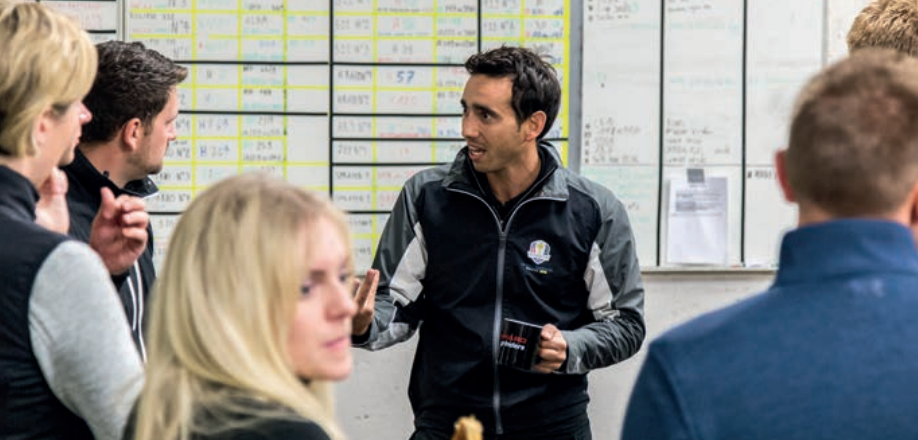 They included superintendent Alejandro Reyes, along with David MacLaren, head of the European Seniors Tour, and tournament director Pierre Antoine Missud, who talked about their careers and detailed the skills that had equipped them for their current roles. What came out was some sage advice on the logistics and organisation required in such events and how the small things can make a difference. “I forgot how easy it is to become blinded at your own venue,” said Amy Yeates, director of golf, spa and leisure at Fairmont St Andrews and the GCMA 2017 Manager of the Year.
“Paul showed us an amazing, yet simple, slideshow – of before he started at Le Golf National – of all the things that were out of place yet clearly visible by the customer. “The small details such as crooked signage, rubbish in the car park, broken range baskets or a negative sign saying ‘range closed’. “We could all find a handful of similar things at our clubs but we choose to walk past them every day and forget that, collectively, the customer’s experience is affected by all of them.
“So my team and I have now introduced ‘photo day’ where they have to show me photos of the facility and all the little things that are both good or need changing. “The simple things are the most impactful.”
Armitage spoke of the rebrand Le Golf National had undertaken to reposition themselves from somewhere that had been seen as a cheap golfing destination. “Our courses were in excellent condition, however, we were asking ourselves (whether) the rest of the experience was poor, and if the Ryder Cup was tomorrow, we weren’t asking ourselves the right questions,” he said.
“We weren’t branded. We were eaten up by the Ryder Cup brand completely, which meant good sales in the pro shop but we didn’t have our own image for after the Ryder Cup, and we changed all that very quickly.
“We’ve upgraded our services massively. Our changing rooms were not anywhere near up to scratch – we didn’t even have towels available.
“We didn’t have one buggy, at a resort destination – so imagine American guests coming here. We didn’t have any rental sets. “We weren’t asking what kind of services do the customers need to make this business work? Our major change is that, now, every decision we make comes from the customers.”
Armitage added it had taken the club nearly three years to make the all changes he wanted, and get the team in place, to make them ‘good from one to 18’.
The desire to improve, whether it is talking about the Ryder Cup, or solving the challenges of a corporate day, is indicative of the passion of Armitage and his team. That struck a chord with many of the young managers out in Paris. Tristan McIllroy, golf and games manager at Roehampton, was certainly excited by the improvements that had been made and how they could apply elsewhere.
“It was interesting to listen to Paul openly talk about the issues that he encountered when he arrived at Le Golf National and what changes he made, including brave ones such as increasing the green fee by 600 per cent overnight,” he said. “The team that Paul has assembled are very passionate and all seemed aligned to ensure the golfing experience is first class. “The short video, to demonstrate to staff where improvements needed to be made around the club, was very poignant and I have certainly looked at things around my club with a sharper eye.” Also key was emphasising the importance of developing relationships with one another and how that was the bedrock of making the project a success.
“It was really refreshing seeing officials in high-powered positions so willing to engage with members and staff,” added James Turner, the teaching professional/ assistant general manager at Ellesborough. “This is something I will do my utmost to adopt myself, as well as other members of staff.”
But equally important for GCMA communications manager Mike Hyde wasn’t just the way Le Golf National developed and embraced people to make their projects work, it was how they were also using technology to make things more efficient. As he explained, however, that wasn’t at the cost of people. In fact, it was a combination of the two that was enhancing the operation. “From a GCMA point of view it was fascinating to hear how Le Golf National have moved towards removing humans from the initial booking process as much as possible, moving a large percentage of bookings online – following a lead set by McDonalds in France, where the company first installed the digital ordering points that are now common across the world.
“The idea is that automation doesn’t necessarily need to mean less staffing, but that it frees your staff up to enhance the customer experience elsewhere in that journey, which has greater value to the golfer than having someone to speak to and initially book the tee time.”
You might not have the Ryder Cup. But there is still plenty you can pinch from Le Golf National that can help you make your club and events that little bit better.
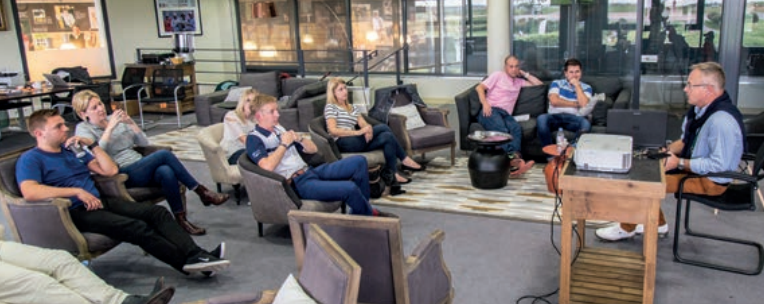 WHAT DOES IT TAKE TO PUT ON A RYDER CUP? LE GOLF NATIONAL GENERAL MANAGER PAUL ARMITAGE DETAILS A FEW OF THE PRACTICALITIES
The strange thing about the Ryder Cup is everything that happens on the golf course, which we manage normally, is not our responsibility from September 1, 2018. We hand over the keys to Ryder Cup Europe. Everything that happens off site is our responsibility – that’s in the bidding document and that’s the French federation and our mission. That’s what we’ve been working on for the last 10 years. So (dealing with) transport are Ryder Cup France, myself and two others on my team and we’re working with the local council, the mayors and a transport company who will be the official company. We have to make sure we have enough buses and trains to get everyone out here, and that’s our responsibility. That’s not Ryder Cup Europe’s responsibility. We have to deliver on that. The Community of Agglomeration of Saint-Quentin-en-Yvelines (CASQY) have put a seven figure sum into the event to help us. It’s the body that groups together eight townships. They’ve been extremely supportive, and they’ve helped on transport, they’ve helped get us planning permission to do our work. For example, for the drainage on the golf course we needed to have a planning and building permit. There’s a field, across from the seventh hole, that is protected land with a farmer working on it. They helped us secure that land, to allow us to have two entrances. Without them, we wouldn’t have been able to have 60-odd thousand people. Health and safety is just a huge responsibility. This dictates when they are going to start each village and various hospitality structures prior to the French Open. So if we’re building for that, we’ll start building at the end of April – that’s already nearly a two-month build. We’ll probably start to see some Ryder Cup buildings appearing by the middle of April, for an event that won’t happen until the end of September. This schedule dictates which parts of the site close on certain dates. It also dictates our budgets, as if we’ve got l’Oiselet (Le Golf National’s 9-hole course) closed down, then we’ve got no revenue and things like that. That’s in our business plan. The Open de France has a new promoter, which is the European Tour, which has helped us immensely as we’re only talking to the same promoter about both the Open and Ryder Cup. There are three production companies coming in for the TV coverage and we’ll use the same area for both the Open and Ryder Cup. We’ve put fibre optics in all over the golf course, so they’ll almost just be plugging and playing. They won’t be have to lay cables all over the course.