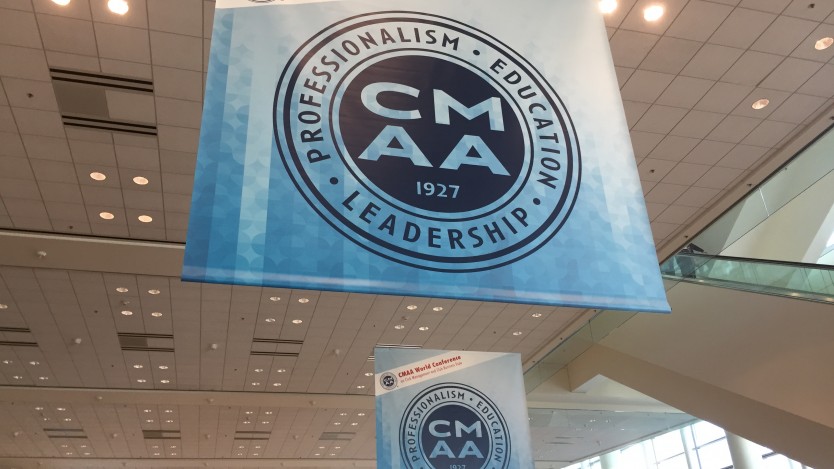
GCMA communications manager Mike Hyde attended the CMAA World Conference in San Francisco. He reveals what he learned and how clubs might benefit…
Club Brands: Why Different Is Better Than Better
It’s good to be better, but it’s better to be different!
“Find out who you are and do it on purpose.” Dolly Parton
When an advertising company added what made their product different (rather than just simply better) to their digital marketing ads, the click rate went from 1% to 3.5%.
Your marketing messages should be just the same as if you were showing a prospect around the club — be as passionate in print and online as you would be in person.
I really liked the idea of Brandable Chunks — ‘a micro-differentiator’ which sets you apart.
Such as the upmarket hotel that delivers homemade bread in a can-delivered on a rustic board with the recipe, the junior swim programme simply known as Turbo Turtles or the club with a Popscicle Hotline — a phone by the pool that if you use results in an instant ice lolly delivery — brandable chunks simply give people a chance to talk about you.
On a similar note, ‘Easter Eggs’ are a lovely way to deliver member engagement. Little touches that you need to be in the know about, which make your members feel special. For instance, one club keeps free cookies under a glass jar on bar, which is a nice touch, but all the member’s children also know about the tub of Oreos that are kept in a trunk in one of the hallways.
Isaac Lidsky Keynote
I took so much from this session, much of which is hard to summarise in a few bullet points, but Isaac’s incredible outlook on the world — having lost his sight but gained vision — left a lasting impression, with some of his key messages including:
Improvement is all that matters, not achieving perfection. Striving is all that matters
We need to only consider two questions in relation to any one issue:
What am I trying to do
What can I do about it / what’s the best next step
No one has ever gone from A-Z — only A-B. Take one step at a time.
I’ve been thinking a lot about how one learns to lead. Isaac offered a fantastic distillation of what he aims to do: “I just want to build and motivate a team with a shared vision and strive for excellence.”
If I take one thing away from this conference, it’s the following quote from Theodore Roosevelt, which I think was presented in the context of your own thoughts, but I’ve already found to apply very effectively to outside influences:
It is not the critic who counts; not the man who points out how the strong man stumbles, or where the doer of deeds could have done them better. The credit belongs to the man who is actually in the arena, whose face is marred by dust and sweat and blood; who strives valiantly; who errs, who comes short again and again, because there is no effort without error and shortcoming; but who does actually strive to do the deeds.

The art and science of storytelling
One of my favourite sessions.
Stories help set you apart. Creating stories allow people to retell them and create word of mouth buzz.
What is your xfactor? What is unique about your club and what would a member want to tell someone else about?
A nice way of beginning to craft short stories is to create a brief but memorable statement — a variation of the elevator pitch, which you should be able to deliver in 6–9 seconds, and it should force someone to engage and ask the next question about you or your club (it’s equally applicable to personal branding).
Like the world leading surgeon who treats stroke patients — unblocking blood clots to restore blood flow — who describes himself as “an expensive plumber”.
This is the neatest example of how you can use other language to express the same thing, but differently, but evoke an entirely different set of emotions — in this instance, utter empathy:
We ran through a really nice exercise in which everyone quickly described playing golf at your club in the most detail they could think of? “Describe the scene on your first tee and how that makes you feel”
This was one of the first answers — absolutely a rough draft, but a great starter for ten and an example of how emotive language can be incredibly persuasive. This certainly made me want to play golf!
“You walk out to the first tee past the towering century old pines, to the tee that has been cut to that morning by Joe — whose family have tended to the course here for 76 years — surrounded by flowers planted by the members and your predecessors. As you swing back towards the historic white stone clubhouse and send your ball soaring into the crisp Californian air, and set off towards the lakes: you know it’s going to be a good day”.
Networking for Results
I really like the concept of networking being a business strategy and professional competency that can be learned, and, more importantly, practised.
The process of networking was broken down into some distinct phases, all of which are clearly important, but I think the one I’ll take away immediatelu is the start of the relationship, which happens in the first 0.7 seconds, during which time you “only” have to make the Initial contact , offer a smile, and begin to introduce yourself (which should also be followed by a complement).
Remember the T.E.S.T test:
Take charge of the conversation (imagine and act like you’re hosting your own party)
Enthusiasm-imagine the next person you meet might change world — it’ll resonate
Smile (sincerely)
Total focus on the other person
It was pointed out that whilst this sounds like common sense, that doesn’t make it common practice.
It’s also okay not to remember a name you’ve been given in that first stage — it’s the most stressful part of a social interaction, so it’s okay to ask for clarification later.
Develop a “personal introduction strategy” — a short introduction that you can roll off the tongue without thinking is invaluable to making new contacts. It can be as simple as smiling and asking someone how far they’ve travelled, but it gets the ball rolling, minimises anxiety for both parties, and you’ll come across as more professional
It’s also fine to ask for someone’s contact details early on, and make sure to ask for permission to follow up. Noone will say no, and it breaks down the initial barrier and makes a response more likely.
Finally, when you’re at a networking event it’s fine to want to move onto a new conversation — just remember to take their feelings into account before you move on. “I know there’s a bunch of people you’d like to meet so I won’t take any more of your time. But it was great to meet you” does the trick just fine.
Planning Success
Always present key any documents as drafts — it gives you the option to continually update, and prevents people from resenting you if they see a “final” version if their ideas aren’t in there
If you hold focus groups for a particular project, give feedback for good contributions. Simply keep a note of key suggestions during the meeting and follow up with them afterwards to say it was a good idea. They’ll feel invested, regardless of whether it makes the final cut.
If you are holding focus groups about a project in which you are personally invested, try to just present where you were, where you are and where you are going. Then have someone else facilitate the session and just observe the discussions.
Curt Cronin Keynote
As a former Navy Seal Curt offered some fantastic insights into the possibilities of teamwork, once someone understands how their tasks fit in the greater picture. Beginning with the simple analogy of someone who thinks their task is simply to make bricks being uninterested in their task. Explain that those bricks will be made into a wall, and they begin to understand their purpose, but convey that those walls will become a cathedral, and they will become truly invested in their job.
I also loved the way he turned the thinking of the NFL player who was soley motivated by becoming a hall of famer, and therefore played in a selfish way. Once it was explained that he needed a certain number of games to likely be considered (based on the average of previous HoF players), and therefore that by contributing to team success he would add extra play-off games to each season, he began to teach the defensive players some of his offensive tricks, raising the team’s performance, and increasing the chances of him acheiveing his own personal goals.
Club Technology Trends
The future isn’t that far away. One club is already investing in a fleet of driverless cars that will be able to collect members and bring them to the club — what an incentive to visit, and encourage spending in the bar as no one has to worry about driving home,
You should always be questioning your technology provider about their security plans -have they updated and patched their systems to the latest releases? It’s perfectly reasonable to be asking those questions.
You need to create an IT security plan, with every aspect of your club’s technological infrastructure mapped. Remember, these days even your irrigation system and CCTV cameras are liable to be hacked, and need to be secure.
Geofencing and beacons offer huge opportunities for personal service. The former allows your club app to recognise when a member is driving to the club, and to alert them which car park they should use, whilst the latter works in closer quarters in the club — such as when a member is walking towards the reception desk, and their name and usual drinks order/recent golf result/favourite table in the restaurant can pop up for the staff to greet them.
No man has ever quit a private club
One point that seemed to get universal agreement in the room was that very few clubs invest in facilities for females to the same extent as they do for men — i.e the women’s locker rooms are never fitted/maintained to the same standards as the men’s. Until that is fixed, your club is always paying lip service to diversity and equality.
Tame the chaos: overcoming complexity to achieve real results
Erich Randall openly admitted this was a day long course, which he did his best to squeeze into 90 mins, so there was a lot of detail, and one particular tool nearly got lost, which I think sounds incredibly valuable — the Five Whys technique.
Put simply, if you have a problem, try and identify what the underlying issue is (i.e what’s causing, or why you can’t fix that problem), iterating five times until you hopefully reach the root cause of the problem. It might need a second time around, this time finding different responses, but it seems a very effective way to get to the bottom of a problem.
e.g. (shamelessly tweaking the Wikipedia example)
Problem: the fairway mower won’t start
1. Why? — The battery is dead. (First why)
2. Why? — The alternator is not functioning. (Second why)
3. Why? — The alternator belt has broken. (Third why)
4. Why? — The alternator belt was well beyond its useful service life and not replaced. (Fourth why)
5. Why? — The mower was not maintained according to the recommended service schedule. (Fifth why, a root cause)[2]
I also like the sound of the slight alternative — Five Hows — which gets you to a solution to a problem by continually refining how you can fix the underlying cause(s).
Employee engagement, staff retention and organisational culture
In a neat reference to Curt Cronin’s session, it was mentioned that although some people may find it surprising that even junior (or apparently disinterested) staff care about what the organisational strategy, and that staff can be easily engaged by understanding their role in its delivery.
Chip Conley Keynote
Based on Maslow’s hierarchy of needs, by satisfying each level of expectation below, organisations can inspire the related consumer behaviours:
Satisfying Expectations — creates satisfaction
Satisfying Desires — creates commitment
Satisfying Unrecognised Needs — created evangelism
(a la Steve Jobs — people didn’t know what they wanted until Apple showed it to them in the form of the iPod/iPhone/iPad)
With parallels to the storytelling session, Chip recommended identifying what business you are truly in — iterating answers and continually refining.
For instance, whilst they are, in basic terms, an internet travel company, Airbnb identify themselves as being in the ‘Belong Anywhere Business’. This creates an emotive drive for your company.
Use feedback as your compass. Chip advocates quarterly business reviews, and the same for staff, on the basis that the average length of service of hotel employees is 11 months but most hotels only conduct performance review at 1 year!
If you don’t evolve and disrupt yourself someone else will. Although it’s worth bearing in mind that most disruptions are foreshadowed. For instance AirBnB was predated by Craigslist and Vrbo.
What are the big waves you’re seeing in the world that foreshadow a disruption in your industry? One day someone will stumble on the idea that destroys you or your industry.
You can’t stop the waves of disruption but you can learn to surf!
The CMAA World Conference took place in San Francisco from March 2-6 2018.
By Mike Hyde