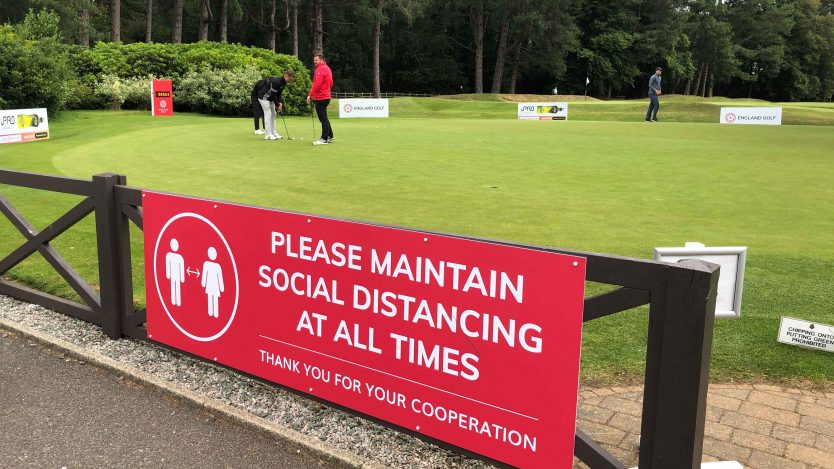
Are we facing another year dominated by Covid or will we be able to move on? We asked a trio of GCMA members to consider how the next 12 months will look…
It’s been hard to plan with any certainty since Covid-19 started dominating our lives. And yet, planning is at the heart of every successful golf club operation. So as we look at the year ahead, is it merely about getting through the pandemic or are other factors at play? How will membership look? How are clubs starting to focus on the future? We asked three managers to get out their crystal balls.
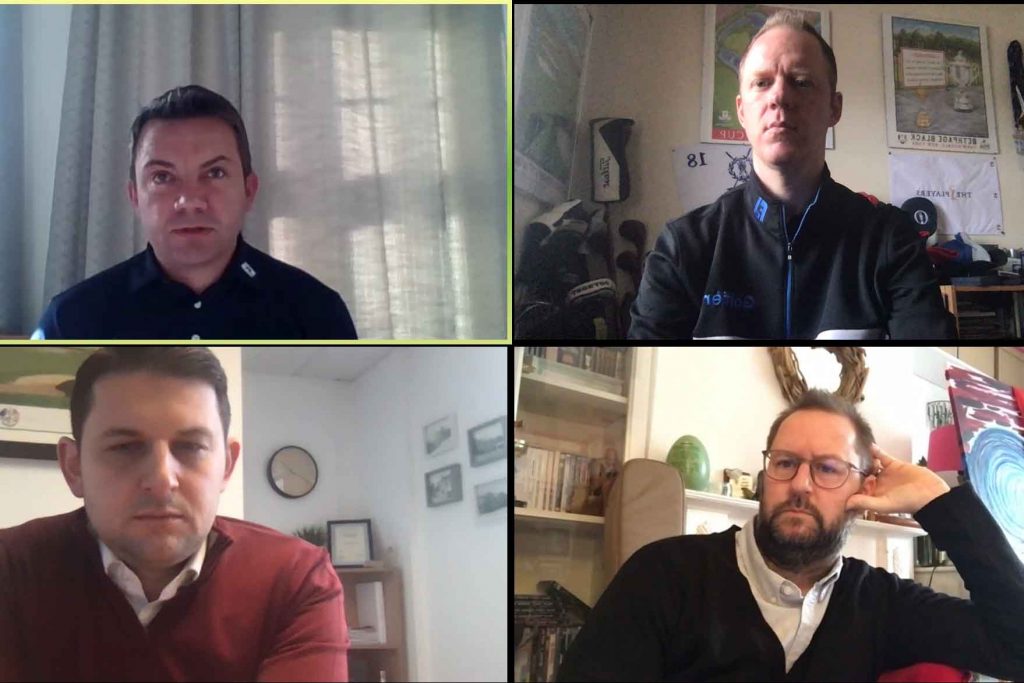
Meet the panel: Ben Driver, general manager at Chigwell, in Essex; Tom Munt, general manager at St Ives, in Cambridgeshire; and Simon Bell, assistant manager at Basingstoke, in Hampshire
Is coronavirus going to be the biggest thing for you and your clubs this year?
Ben Driver: We know the clock’s not going to strike midnight on January 1 and it’s all going to go away. It will very much be on the agenda. There are never-ending things in the diary we need to think about. Being a members’ club, there is Captain’s Drive-In and our renewals are sent out in February.
The Prime Minister has talked about the new tier system being here until March. Given the fact it will cover our renewal date next April, I think it will be a huge thing.
Tom Munt: Our renewal date is July 1. In some ways, through this pandemic, that’s fallen relatively easily for us.
When we’re talking about the effects in 2021, it’s a really good point that most clubs are hugely reliant on a single event. Our renewals are, generally speaking, the thing that dictates the next 12 months – for better or worse.
Even if the pandemic is done and dusted by May, anyone who’s had that significant event before then will see its massive impact on the rest of the year. I guess 30% of our business is hospitality. For other clubs it is more – 60%, 70% or 80%. It’s about how consumer confidence is going to pan out in that sector.
We’ve had a roller coaster (in 2020). You can’t go to the pub, can go to the pub, half price to go to the pub.
I don’t know how long it will take until we get anywhere near the kind of levels of trade with functions, the Rotarians coming back, and all the other staples in the golf club function diary. It’ll definitely be the overwhelming consideration when we’re planning.
Simon Bell: How people feel, when it comes to their renewal date, will actually dictate whether they commit, won’t it?
Ours are in March and we will have a far clearer idea by then whether we will be getting back to a relative normal quite quickly.
If that is pushed back, the renewal gets that much harder. But if things moved quicker we will actually have more customer confidence to commit to that annual big payment.
BD: By and large, the actual playing of the game has remained pretty much untouched. Well, not untouched but, hopefully in 2021, that just won’t be too much of a concern. It’s everything else. It’s the events, it’s the dinners, yuletides – the added value to a golf club. That’s going to be a concern.
We’re not a wedding venue but I worry for clubs that are a huge wedding and party and birthday venue. It’s going to be interesting to see what happens. Hopefully, golf will stay but clubhouses? That is going to go long into next year. Certainly the first six months.
TM: We’re 70% golf income and 30% hospitality. How does your club set up Simon?
SB: Very much like that. We have few weddings but a lot of member functions. I only started there one week before this lockdown.
So it’s been very weird going into a brand new venue knowing no one. I have met lots of people but don’t know what anyone actually looks like because of wearing a mask. It’s been very odd putting names to faces.
We are very much member function based with not much coming from outside. We have a full membership and lots of good functions – Christmas meals, monthly steak nights and things like that. The club is very well supported, which is lovely.
Let’s move on to membership. We’ve had this boom where lots of players flocked to clubs. How do we keep them? You’ve all got different renewal dates so have separate challenges…
BD: The return of football and not just football, but everything: cricket, rugby, weddings, events and barbecues can’t be underestimated. It’s fantastic we’ve had this renewed enthusiasm.
Obviously, in the early days of opening up, golf was the only thing you could do. To some extent, it is still true.
But we’ve got to be wary of the return of these other things that take time. We can’t get complacent now. We’ve got to bang the drum as to the benefits of golf and keep banging it.
I think the nation has woken up to it a little bit. It’s been mentioned a lot on a national scale but we’ve got to be wary of the return of some of the other things members and golfers are interested in.
TM: I’m inclined to agree. We’re slightly different in that we’re a big commuter area so we’re about an hour from North London and we have an awful lot of people who work in the city.
A lot of our increase in membership has been brought about by people working from home. We have huge numbers of lawyers and accountants and various other people who would normally do 60 to 80 hours a week in the city plus travelling, who suddenly find themselves at home only having to do 40 hours a week, or are even partly furloughed, and a lot of them have come to the golf club.
The sad reality is that while some businesses will choose to remain benefiting from that flexible working, and the cost savings that go with it, they won’t all. All of us know that once the foot is put back on the pedal, the pressure will be on for these people at home or at the office to deliver again. I think, very quickly, they’ll come back into the cycle of working every hour god sends and we may be a casualty of that.
We are hugely focused on what we can do to retain those people that can be retained. In the same way as every year, when any one of us looks at our membership numbers, we kind of put a line under 10% of them and expect them to move house or pass away or become ill. There’s an element that you know you’re going to have some churn. It’s short sighted to think the easy win on the back of Covid is not going to have a much more significant drop off than your normal organic growth through the year.
SB: The acceptance that you will lose many of these new members now is key and not to view that as failure. What worries me more with many private golf clubs is that boards of directors may not now appreciate that we are going to lose lots of these new members. We shouldn’t be budgeting with them all hanging around and paying full whack. We need to be realistic about what we are actually going to benefit long term, which might not be that much.
TM: And there’s some of the PR, should we say, that has been coming out of the world of golf. Not necessarily the professional world of golf we live in, the slightly sort of dull management side, but from England Golf and from others.
They’ve all jumped very openly on the back of this good news story. I totally understand why that is. But you’re right. When you’ve got a board of directors, who are getting these messages, it is difficult to be the only one in the room trying to calm them down and say ‘hang on a minute’.
You might be faced with: ‘Why haven’t you budgeted to grow membership another 20% next year?’ You say, ‘well, it’s not going to happen’. And yet, other people are saying there are 400,000 more people playing golf this year. You think ‘well did they get that number off the back of the cereal packet?’
It’s not real life. With a members’ club, it’s another job to translate the reality to those people who are ultimately making decisions, at general meetings and so on, without coming across as a doom monger, to say ‘look, this is good news. We will have more members at the end of this than we had at the beginning of it’. But let’s budget. Let’s get our expectations in a place where they’re realistic and we’re not going to end up tying ourselves in knots.
But the perception is these are great times. There is an acceptance people will lose their jobs in the future but I don’t often hear managers saying ‘we’re going to lose these members’. How do you get your boards or owners to brace for that?
SB: It’s coming back with the reality that there is going to be a financial hole in the economy. We don’t know where it’s going to hit most. It might hit young people. It might hit retirees, which is our core membership. If those guys get hit worst, we’ve got real problems.
There are many factors: job losses, will inflation go up? Will people change their spending habits? There are so many unknown elements going to pop up so we have to make owners and board members think more cautiously as well.
BD: Obviously our skill set is going to be put to the test. This year, we have very much been operators. Let’s not lie. We’ve not had to do anything really proactively to advertise the club or golf. We’ve simply had to operate and really manage that demand.
In 2021, there will be some of that but we will all be put to the test in terms of marketing and keeping that message going.
In terms of how we brace the board, clubs that survey their members really well will benefit – clubs that really have a handle on their membership and their playing habits.
I think we’ll get a better insight as to what the next couple of years will look like in terms of membership. The members that have joined this year – how many times have they played?
We’re all using tee time systems now, and so you’re getting these reports. You are seeing how many members are playing.
So I think really looking into your membership and their playing habits and surveying your members, maybe in the first quarter of the year to see where they’re at and in terms of how much they’re enjoying the club and the course, is going to be important. I don’t think there will be a significant drop off but I think we’re going to be put to the test in keeping that positive message going.
We’re all, as managers, trained to be on both sides of the fence. We’re all cautious, in the middle ground, and stabilising everyone.
TM: We’ve spoken to all of our new members. I know why they’ve joined, where they come from, what job they do, and what sport they’re not able to play.
I report to the board relatively regularly with what I believe to be our at risk membership. Every club has their ‘if they’re alive, they’re a member’ group and then you have others who come and go to varying extents.
Certainly the members we’ve acquired at the moment, probably over 70% of them sit in that group. I expect there will be significantly less than that. Publishing just the numbers and showing huge growth is great.
But I’m sure at different clubs the new members will have come from different places and will have different reasons for taking up the sport.
So some clubs may see 50 to 60% (of them) go. Some may only see 10% go. But I do think understanding where they’ve come from, which you have to do on a personal level, means that most managers are cautious and have a big job to do in riding out the success. I certainly don’t feel like this is the new normal. I feel like this is Covid and afterwards, if we do it right, it will be better.
BD: We’ve been given an opportunity and it’s our job to map that and capitalise on it.
It’s easy to let the pandemic define everything. Covid aside, what are the key drivers for your club in 2021?
SB: Any members, new or long term, had a very good golfing experience in 2020 and hopefully we can carry that on. Golf courses looked great because they had the spring off and we had wider tee times.
When they came in they were given table service and more personal service and so I’d like to really use those positives to keep carrying on this message that being a golf club member is a great experience.
As we come out of the pandemic, there is going to be this euphoric feeling around the whole country and the world that we have beaten it. That gives us huge opportunities to say ‘last year you missed out on your weekend lunches, why not this year come to all of them?’ There is going to be a large part of the golf world that wants to make up for last year. That gives us chances to use that to our advantage.
BD: We’ve had a lot of younger members join. We’ve had over 100 new members across all categories but, in the full category, over 70% are under 35, which is fantastic.
We’re going to focus on keeping the fun factor.
Golf is a modern sport as we’ve all seen the fashions changing. Our social media is going to keep driving that – the message that golf is a trendy sport and not just for fashion but in the clubhouse as well.
We want to try and develop that and appeal to the younger member. They have joined and we want to keep them now and we don’t want to show they’ve joined a club that is not prepared to move forward and look at their offering.
TM: For us, it’s about the hospitality offering. I completely echo what Simon said. I think, in a very strange way, last year allowed golf clubs to significantly raise their game in lots of levels.
I agree with table service. Our members were spending twice as much in the clubhouse during the summer, in a large part because we were going to the table and serving them. In the short term, keeping that new level of expectation going is really important.
In the longer term, 2023 is our centenary. We’re looking at some development projects, including a new par three course, and we’ve got a nice driving range facility with Titleist placed there.
We’re looking at developing that slightly further. We’re looking at creating some additional facilities. Our course is relatively young – it’s 10 years old – but it can be pretty brutal and we’ve found that is quite divisive.
Moving forward we need to have a slightly better entrance for those younger people that aren’t yet in the game. We’ve had a taste of what can be achieved if we do push standards up. Members loved it. We’ve got new members who only understand that level of service. Next year will be all about delivering that or above.