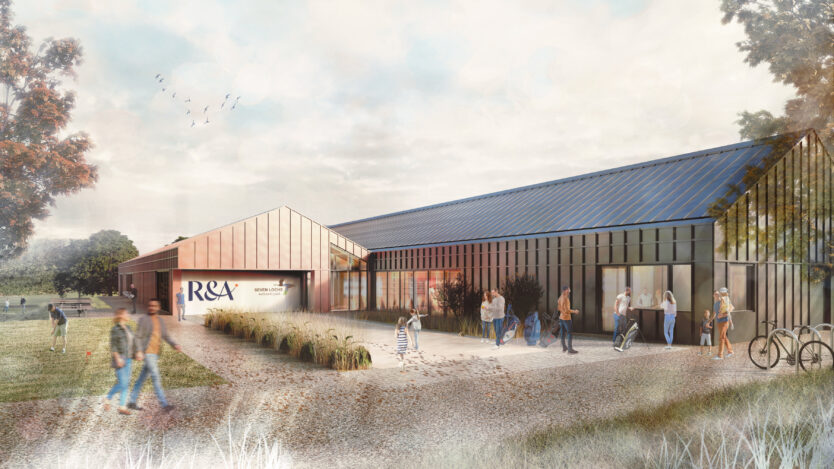
A huge Topgolf, a new R&A entertainment facility, and a Golf.Golf pilot that’s all about increasing participation. There’s a lot going on in Scotland, and the governing body are playing a key role…
This article is part of GCMA Insights – topical content for golf industry professionals, discussing the things that matter to those who work in golf clubs.
You can find a course to play on Scottish Golf’s website. You can book a tee time. You can also manage your handicap. But for the governing body, this is not the culmination. This is just the start.
“Why not driving ranges?” mused David Kernohan, the Rosyth-based organisation’s Head of VMS. “Why not have the whole ecosystem of golf bookable through the national governing body of the game of golf?”
When Scottish Golf revamped their website and moved their club management software and handicapping over to DotGolf, the same company that drives the World Handicap System for the rest of Great Britain & Ireland, it wasn’t simply about convenience or bringing them into line with the rest of the home unions.
It was part of a wider aim to make it easier for people to play golf – no matter whether that’s at the Old Course or a pitch and putt.
These are heady times for participation in Scotland. Golf club membership is still riding a pandemic boom. There are more than 209,000 golf club members in the country and tech firm BRS Golf recorded just under four million member rounds last year.
The R&A are pressing on with their new Golf It! facility at Lethamhill, in Glasgow, which is set to open in the summer. The same city hosts an enormous three-storey 72-bay Topgolf, and Scottish Golf have recently partnered with the R&A on Golf.Golf – a pilot scheme which aims to attract a new generation to the sport.
The latter project uses a simple website to take players to purposely selected Scottish clubs and facilities which can provide the ideal first impressions of golf.
The aim is to engage people who don’t play, remove some of the traditional barriers which have prevented them from taking part in the past, and use celebrities and sports stars to fire their enthusiasm and keep them hooked.
Get involved in the debate.
To join the GCMA, click here, or to organise a call with a member of the GCMA team, just complete the form below.
“It will do a good job of something that we’ve tried to focus on, and will continue to do so, which is making sure that the golfer’s journey is a seamless one,” said Iain Forsyth, Scottish Golf’s Chief Commercial Officer, of Golf.Golf.
“You don’t need five apps to get you from A to Z. What that opens up is a massive opportunity for more engagement when people are coming in.
“If you want to look at that classic funnel, it’s made the funnel a lot wider because of the reach and coverage the R&A can give it.
“Realistically, you want people to come through that funnel and then, at a point, choose our independent golfer scheme OpenPlay or golf club membership, or look at OpenPlay and then golf club membership.
“But the key is that we don’t lose them because they’ve come in, had 10 lessons, quite like golf and gone ‘what next?’ It’s about ensuring that communication.
“I’ve had a lot of chats with the R&A about that and they’re definitely on the same page with regards to the benefits that it will bring. The challenge to us is just making that journey seamless.”
“The idea has got to be to get more people playing the game more often – even if that’s not on a golf course,” added Kernohan.
“So even if it’s on a driving range, or a simulator, mini-putt or a pitch and putt, it’s all about the game of golf and making sure people have a clear pathway and a clear journey to enjoy and consume golf the way they want to consume golf. That’s really important.”
Golf It! is bound to play a huge role in that. The R&A class it as a “community-based golf and entertainment facility”. While there will be a 9-hole course on site, the sprawling complex will also move both indoors and outdoors as it seeks to make golf “more accessible and inclusive”.
So there will be pitch and putt, adventure golf, and community putting greens as well as a double deck floodlit driving range. But there will also be activities that have nothing to do with golf at all, such as bike hire, nature trails, and padel tennis courts.
“Our aim is to create a destination for golf that is welcoming and attractive to all members of the family,” said R&A Chief Executive Martin Slumbers.

For Scottish Golf, what’s happening at Lethamhill and in Rutherglen at Topgolf is creating an opportunity that must not be missed.
“It’s absolutely fantastic,” added Forsyth. “The R&A initiative is a great one. It’s all about inclusion. What surprised and impressed me most about Topgolf was who their consumer is versus who the average golf consumer is – so to have such a big facility in a relatively small country is a big deal.
“Topgolf are open to working with golf clubs – they don’t have their arms stuck around their own product – and just look at the numbers we’ve been given. I think it was a 50/50 male and female split [in terms of customers] and an average age of 30. Compared to our demographic, that’s a huge opportunity.
“If you combine that with Golf.Golf, combine it with the R&A facility, and you combine it with everything we are trying to do in this ecosystem of golf then you can see strategically how we should get to where we are trying to get to.”
WHY JOIN THE GCMA?
Membership of the GCMA unlocks a network of like-minded professionals, provides you with support in your professional and personal development, and provides you with a multitude of benefits. Whether that’s the tools that will help you to excel in your profession, or a wide range of services to support your wellbeing, signing up to the GCMA is joining a community.
Could that be threatened, though, by a cost-of-living crisis that has curtailed spending over the winter and is set to do so well into the remainder of this year?
Green fee prices, particularly at the top end of the market, are also spiralling ever upwards. Of the most expensive, Trump Turnberry charge as much as £475 for a round on the Ailsa, while St Andrews Links Trust have increased the price on the Old Course by £100 in the last two years. It now stands at £295.
While the governing body does not control golf club pricing, is there a fear – given the pursuit of participation – that the stubborn perceptions of golf being an expensive sport could remain because of high-profile courses charging top dollar?
But for Forsyth and Kernohan, accessibility is chiefly about choice. “We’ve probably got more opportunities per head in Scotland than most countries – if not all countries,” Forsyth explained. “So accessibility can be done in an affordable way.
“There are obviously more expensive places but where I think it has been very encouraging is courses like Dumbarnie, where there is a rate for locals. You’ve got that [in St Andrews] with the Links ticket so it is accessible if you’re local.
“If they continue embracing things that way, I think that’s fair.”
Kernohan added: “With new golfers, I don’t think their first port of call is potentially to jump on a golf course.
“It’s about the R&A new facility, Topgolf, having more driving ranges, having more simulators – that’s generally where the new golfer wants to go and learn the game before they get onto a golf course. They can then work themselves up until they’re playing on a golf course.
“I think we do have some really good price points across the whole of golf and not just based on the amount of golf courses there are in Scotland.
“If you’re interested in any format of the game and shop around, it is possible to find an affordable option on a golf course, driving range, pitch and putt or mini golf facility, we have a lot of options in Scotland that allow golfers the opportunity to consume the game however they choose”
“The driving range, I think, is key,” agreed Forsyth. “If I was to take a friend and they fancied having a go, it wouldn’t cross my mind. You’d go to a driving range.
“So for us to include those in the food chain, and we know Golf.Golf have that in mind as well, will make sure we get those consumers involved in the process.”
Just as important to Scottish Golf’s plans is to ensure that what people are getting, at whatever stage of the journey they are at, is as inclusive and diverse as possible.
Last month, the governing body launched an anonymous survey to all club members, as well as coaches, and its own staff and board, on equalities characteristics.
The first time such data had been gathered in five years, it asked respondents to self-identify their ethnic group, sex, trans status, religious denomination and sexual orientation.
It aims to help the governing body understand where there is a need for more equitable practices which do not disproportionately and adversely affect minority groups or those with protected characteristics.
Andrew Baptie, Scottish Golf’s Head of Club Services & Governance, said: “We want to take meaningful measures to improve, and to do that we need to be fully appraised of the current landscape.
“The survey results will give us valuable insights into how we can generate a more diverse and inclusive game in Scotland, and how we can support our membership to continue to do the same.”
So by aiming to create a one-stop-shop for participation opportunities, ensuring the game is diverse, inclusive, and fair for all, and by backing and supporting some impressively ambitious projects that have sprung out of the pandemic, Scottish Golf are hoping that what we’ve seen in the last couple of years will only be a springboard to even brighter days in the future.
It will certainly be interesting to watch.
We may still need to keep our fingers crossed. He said: “The journey to great spring putting surfaces is a complex one, reliant on many strategies, and hoping the British weather helps out.”
This article is part of GCMA Insights – topical content for golf industry professionals, discussing the things that matter to those who work in golf clubs.
Get involved in the debate. To join the GCMA, click here, or to organise a call with a member of the GCMA team, just complete this form and we’ll be in touch!
Enquiries
"*" indicates required fields