They are fighting for the same business but, in this month’s Matter of Opinion, three Yorkshire managers reveal how teaming up has helped them meet the challenges they face in their day-to-day jobs…
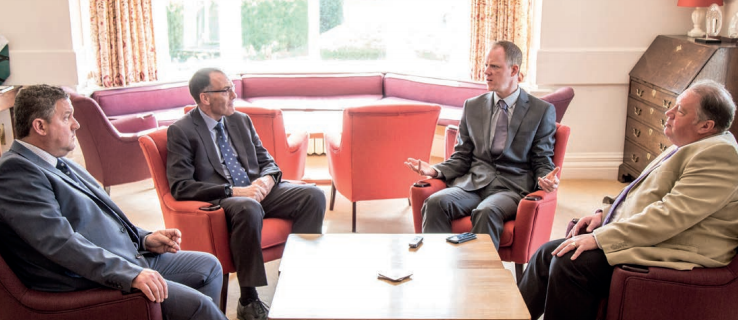 The serene setting of Ganton, with its history and tradition, was the venue for the recent Yorkshire spring meeting and, alongside the networking and business presentations, we took the chance to grill a trio of local managers about what affects them in their offices. Considering social media, joining fees and tee time companies, Scarcroft’s Mick Thorpe, Pontefract & District’s Malcolm Huddlestone, and Garforth’s John Dexter revealed three heads are often better than one…
The golf world is changing all the time, which means your jobs are getting more challenging. What are those challenges?
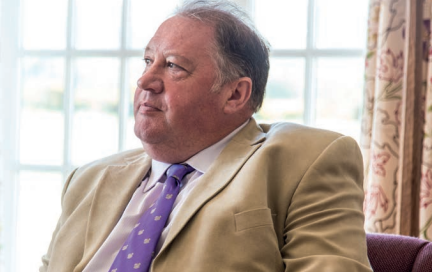 Mick Thorpe: Every club has its own challenges. We’re at a very traditional golf club at Ganton and Scarcroft sees itself on similar lines to here and now they are having to realise the challenges of progressing. We have to change and adopt almost a different mentality to attract new players into the club. It’s not just membership, but visitors as we
You are trying to get all different kinds of people to come and play and experience what we offer. And what we offer has also got to be what they want. I think at many clubs there has been a reluctance to change and take that challenge on. We’re in north Leeds and there are lots of different clubs. People have got so many opportunities, and so much choice, that you almost have to have a niche where you offer something slightly different.
Knowing what they want is not always perceived by your own members.
It is a very difficult challenge and not just within the clubs. I think I know how we should progress. The first thing is getting that across to your own committee and members, and getting them to accept that, and seeing that as accepting the challenge.
 Malcolm Huddlestone: Evolution rather than revolution is probably the key. I think everybody accepts that if you don’t change anything then you get the same results. Certainly at Pontefract, the last time we had a waiting list, for example, would have been in 2008. In 10 years, the demographic of a golf club has changed. The average age of Pontefract members is 59, which is probably a lot younger than most other clubs. But it does tell you that you’ve got an awful lot of over 75s who are able to play golf longer. That side of it is probably in a healthy state but then you’ve got the opposite end where recruitment is a fire-fighting exercise. Every time you look at the renewal process you are then spending the rest of that following year bridging the hole that has been left behind by members who have chosen not to renew.
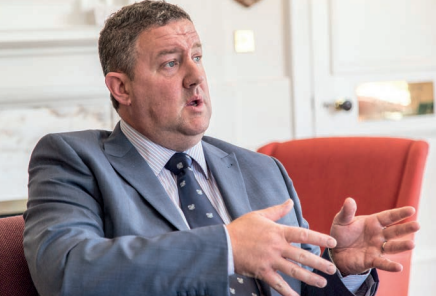 John Dexter: It’s about knowing what you are and what your strengths are. What’s your unique selling point? Obviously we are in an industry and a business and Mick touches upon what I call the north Leeds banana. If you look at a map you would see that all the way from the west of the city across the top of north Leeds are a number of golf clubs that are fishing in the same pond for membership. Our strapline at Garforth is ‘let’s be the best we can be’. Let’s understand that we are built on clay, but we are an Alister MacKenzie course. Clay brings some problems from drainage. We’ve got wetter winters and springs. We’ve got to say to ourselves ‘we’re not going to be Alwoodley. A premier club within Leeds. We’re not going to be Moortown. We haven’t got the turf for that. But we can be the best that we can be and for our members as well’.
We don’t want to give them unreal expectations. That’s been very important. We’ve renewed a communications policy – totally renewed it. We’ve gone from not really telling members a great deal and hiding notices on boards and paper strewn all over the place, and are now creating a newsletter that goes out weekly and an informative email with a number of subjects on. It’s to say ‘right, this is what we are actually doing’. There is so much more going on at this golf club than just rocking up to the first tee, banging a ball, sinking a putt on 18 and going home. We have got so much more to offer and it’s that package, as a member or a guest, that we are trying to build on.
MT: That’s important as well, because your retention is just as important – if not more so – than actually going for new recruitment. You have got to keep the members that you have got happy. You’ve got to give them what they are looking for. As you say, you’ve got to be as good as you possibly can be. I’m looking at some of our close neighbours. We’ve got Moor Allerton, who have got a lot to offer for visiting parties with having 27 holes. We’ve got Leeds Golf Centre, just down the road, who are exceptional and are Club of the Year. They are really good with the practice facilities and the juniors. We cannot compete, but we are better at other things. There’s room for all of us. There is less room than there used to be, but there is room there. We’ve got to excel at what we have got, what we are good at and offer something different because there is an audience out there for different things.
So you are all private members’ clubs?
All: Yes
MH: I often say if we could get every club president, every manager, secretary and proprietor of clubs – if we could all get them round a table together and, potentially say, ‘let’s cut out these 2-for-1s’.
JD: It’s market factors, though, Malcolm.
MH: Realistically that’s never going to happen because, as you rightly said, it’s the first rule of economics: supply and demand. But sometimes we are victims of our own success as golf clubs by almost encouraging nomadic golf situations such as society golf and things like that.
”Our strapline at Garforth is ‘let’s be the best we can be.’ We’ve got to say to ourselves ‘we’re not going to be Alwoodley. We’re not going to be Moortown. But we can be the best we can be” – John Dexter
Let’s talk about discount tee times. How does that affect your business?
JD: We made a baseline assessment as we called it. We said ‘when is our course empty?’ We don’t want our course to be empty, because the bar is empty, there is no F&B turnover whatsoever and we are getting no footfall and no exposure. We looked at that and the online booking services. They manage that and say ‘on a Thursday afternoon, we’ve nobody on our course and we can evidence that so £20 a round’.
MT: That’s working smartly, isn’t it? Rather than utilising those companies, we are trying to look at it slightly differently, bring it in house and be a bit smarter ourselves. Yes, do the analysis of when it is empty and so on but use other things like Twitter and social media. I know you’re really good at that at your place and other clubs are jumping on the bandwagon and are the leaders of it. Many years ago, a private members’ club going on social media would be almost unheard of. Now there are so many people out there doing it.
”With social media, you can’t swim against the tide, can you? Love it or hate it, you can’t ignore it.” – Malcolm Huddlestone
MH: You can’t swim against the tide, can you? Love it or hate it, you can’t ignore it.
MT: It’s how you use it, isn’t it? JD: You’ve got to go with it. That’s it. MT: It’s also marketing yourselves. There are other companies out there to aid and assist you. It’s picking what’s best for you and what works for you.
JD: When you read into it, and you actually scratch the surface, there is a lot of gimmicky stuff that’s all very samey for me.
MH: Social media is out there and it is popular. You only have to look at local golf magazines and, basically, they are all promoting the same packages – organiser free and all that.
MT: It just highlights straight away that it’s not necessarily right for all clubs. You pick your own pathway through it. You have slightly different aims and objectives and that changes year on year depending on your committees. So you need to have your strategy much more long-term.
MH: Another key point is to make sure you don’t disenfranchise the people who are committing to your golf club and paying £1,000 a year membership.
JD: Where is the ceiling on membership fees? Because I think we’ve just about reached ours.
MH: Price is the variable, isn’t it? MT: It’s only probably a year or 18 months ago that the challenge was trying to get somebody and prices were going down. Then people realised that you’re actually underselling your product. Your members are paying a premium to be a member but your nonmembers are coming in at rates like £15 a round. You can’t justify that to your own members and you are just shooting yourselves in the foot. I think the industry is now trying to get the right price for the right product.
JD: I don’t know about either of you guys but we took a massive step. Our full membership is full in the male category. We would always take ladies and other groups. We have introduced a joining fee. It’s the first time that has been with us for approaching nearly 10 years. There is a joining fee now that’s half the annual sub. That’s caused a lot of nervousness and hand-wringing because we are not silly. We look at other clubs and they do not have joining fees and will desperately take on new members. Is it in your pipeline Malcolm?
MH: I thought we had an excellent scheme where we charged it over a three-year period.
JD: Ours is two years.
MH: We ring fenced that money and we actually gave them it back if they were still a member in years four, five and six – because that shows commitment both ways.
”Where things have changed and attitudes have changed is that we, as clubs and managers, get together and try to work together”– Mick Thorpe
JD: The money was returned? The joining fee was returned? That’s interesting.
MH: They paid it in year one, two and three. It’s £550 and if they were still a full playing member in years four, five and six then we gave them, basically, that money back.
MT: We have a similar scheme – a member benefits scheme. It can be professional lessons, it could be on your card.
MH: In my five years of being at the helm at Pontefract – with new members – if you kept them for three years then they will make good club members. There are that many people looking for deals that, frankly, as long as they are with their mates they are not bothered to an extent where they play their golf. Again, price is the variable.
JD: They say, don’t they, if you get them for two years you have got them for 10? That’s a comment that’s thrown about. We’ve introduced a mentoring scheme because it’s difficult. It’s like being a new kid at school. That’s the reality of it.
MT: Can I just go back to what we were talking about earlier and people having value for money and also the clubs having different things to offer? We were strongly competing against each other. Obviously, with there being so many clubs within a short space in the local area, it was really difficult. I think where things have changed and attitudes have changed is that we, as clubs and as managers, get together and actually try to work together a lot now – or a lot more than we did. It’s not every club. There are still some that tend to think they are better off on their own, but we speak, air opinions and we understand each other. That has been beneficial and I think it’s been very healthy. We still know we are competing. We’re competing for members, we’re competing for footfall and visitors. But we don’t try and blow each other out of the water. We try to assist in many areas, which I think is healthy for the industry. I think it’s been very insular. People have been looking at their own course, and their own income stream and it’s much more important we have a good industry. That’s where it’s let us down over many years. We haven’t been high profile enough. I said it years ago. When cycling was successful, they sold themselves really well. I don’t we as an industry did