 So you’ve sold off some land, but do you really know how to manage the proceeds and the regulations you have to follow? Frilford Heath chairman Alistair Booth explains how you can maximise the return for your club.
With three courses set within 500 acres in Oxfordshire, Frilford Heath are determined to set themselves apart as one of the UK’s “favoured golf destinations”.
Key to that mission statement is investment, not only in their principles and people but also in their facilities as well.
When the club, who have around 1,200 members, decided to sell some of their land, they went through a detailed process to make they got the most of the sale – both in terms of revenue and delivering the capital projects they wanted to build. Alistair Booth, chairman of Frilford Heath, explains how the club managed the sale, how they invested the proceeds and why they took that route…
The decision to sell
We had a short practice area, which was on the right-hand side of the drive as you entered the complex. We’re fortunate to have three practice grounds, but this was only really large enough for play up to an 8-iron.
We sold three quarters of it and left a border of about 50 metres coming down the drive.
The idea was for a developer to build five executive houses that were in keeping with those which run along the main road.
We employed a land agent and talked about what we wanted to
do and why. He undertook some preliminary investigations with the local authority about the likelihood of getting planning permission.
He gave us a valuation of what the land would be worth and drew up a brief, which went out to a number of different developers,
inviting them to tender and giving them an indicative value.
He presented the responses to us and any plans drawn up for the development of that land had to be agreed with us before they
went for final planning permission.
 The project
We wanted to improve and enhance our facilities. But you could draw up a list as long as your arm of what you wanted, or needed, to enhance and it was a case of prioritising them.
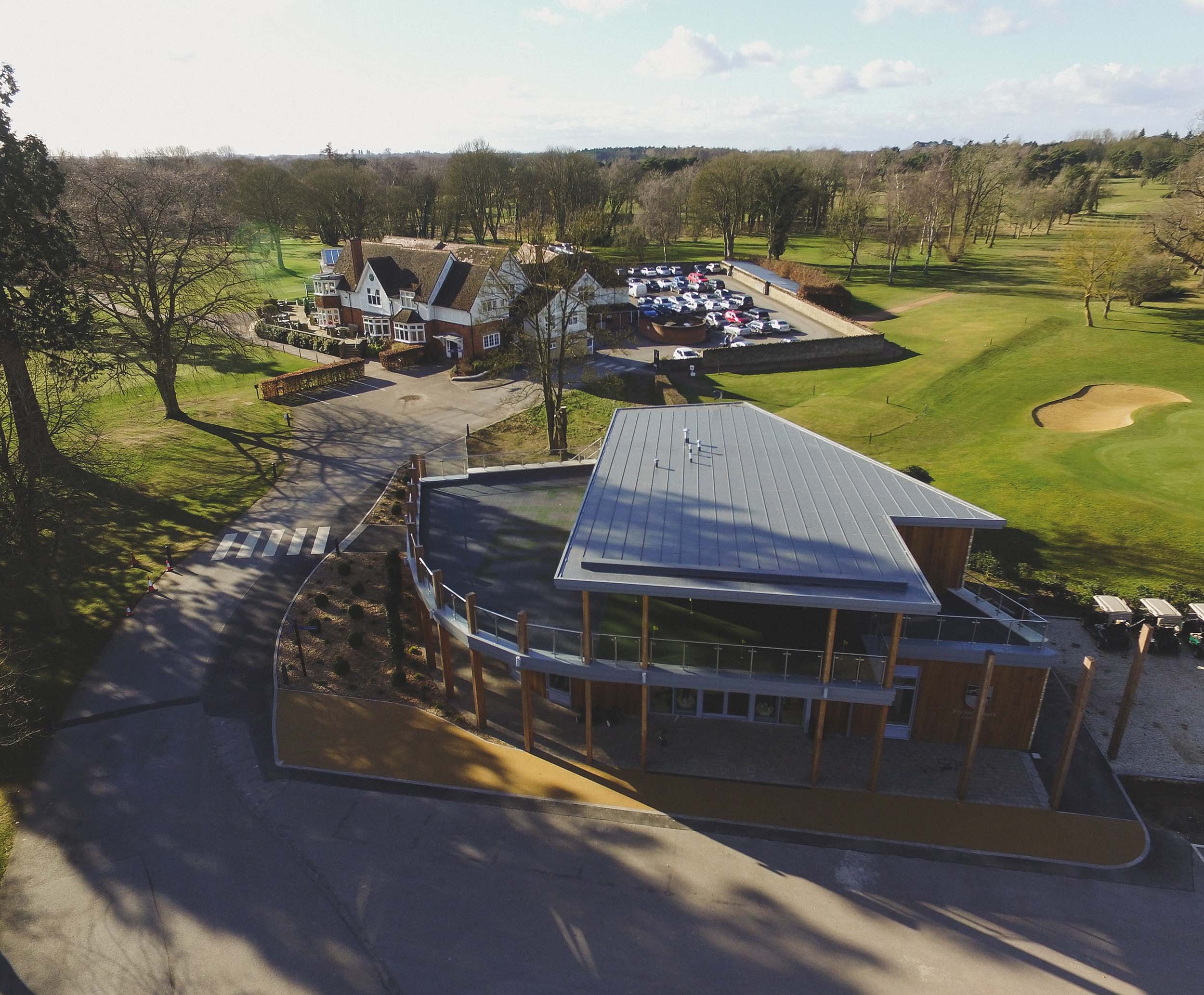
The clubhouse is a converted country house and our main concern was that anyone coming to Frilford Heath for the first time would see a blue door in the corner of this building and they didn’t know if that was the way they went in.
We also realised that our golf shop, at the rear of the building and in a corner, was in totally the wrong area.
We felt we could kill two birds with one stone, which was to have a golf facility which was more appealing to our members and that also acted as a visitors’ hub. So anyone who came to the club would see this new building and they would know where to go. From there, they would be directed to the clubhouse, the changing rooms or the courses.
Why a new building was so important
As it was a brand new building and facility, it was eligible for Business Asset Rollover Relief.
When you sell land, you either pay tax on the profit you make on selling it – circa 20% – or you reinvest it into the business.
You have do that within a three-year period and if you do that you get Rollover Relief, which means you do not pay (capital gains) tax.
The very first thing we wanted to do was build this new golf facility for our members and visitors – while also acting as additional office facilities to relieve the load we had in the clubhouse.
Rollover Relief was important but not the driving force. We didn’t, though, want to give a substantial sum to the taxman when we could invest it in the business. It was important we built something that was relevant, pertinent and also provided us with some Rollover Relief as well.
We also carried out a second project very quickly as well. The comments that came back from some members was that we had taken a short practice facility away from them. We had some land at the end of a car park that was a spinney and, with the general manager, I went in there and thought ‘what if we cleared this out and turned it into a par 3 facility?’
It would mean members had a place to practice their short game around six holes. It would mean we could open it to members who had family that didn’t play golf but wanted to introduce them to it.
It’s a facility where we could introduce children to golf and where older members, before they hung up their clubs, could say ‘I’m going to play the par 3 course’.
We had to clear away 90 trees and get permission for that and we planted 90 other trees in the estate. It was a brand new facility in which we were also able to obtain Rollover Relief because it was something we didn’t have.
Managing expectation
We want to engage with our members. We are a golf club. We’re not a health club, a country club or a sports club. We shared with them why we wanted to build a new golf shop. We shared the plans, all the details and showed various presentations. In the main, they were very supportive and excited about this new facility they were going to have.
A pattern for investment
The members did not have to pay for it. That was important because we’ve got a number of capital projects planned and our philosophy is to get the financial resources to do those without turning to the members and saying ‘right we want to levy you £5,000 or £10,000 because we are going to do this’.
We’ve got an estate of 500 acres. We’ve got plots we believe that, over a period of time, we can sell and which do not interfere with the golf course. That will release funds for us to do the capital projects we need and improve the facilities for members and visitors without them having to pay for it.
 My advice to other clubs…
Every club has got to have a clear strategy about what they want to do with their business and a golf club is a business – whether it’s a private members’ club or a proprietary. What is the strategy? If it’s a private members’ club – what do the members want?
What is best for the golf club business? That’s not just looking at the present, but in five and 10 years’ time as well. If you are fortunate enough to own your land and can dispose of some, it’s important to look at what it is your customers want and whether that is part of your strategy. How can you use that to drive the business forward and enable not only its survival but its success going forward? You are ensuring, as much as possible, that you can maximise your tax relief on the land you sell.
But I don’t hold myself up to be either a financial or a property guru. I would also advise people to speak to a proper, and appropriate, financial advisor in this area.
FRILFORD HEATH
With 500 acres of undulating heathland and three courses – the Red, Green and Blue, along with the 6-hole Yellow – Frilford Heath is one of the best venues in the South of England. Aiming to be one of the UK’s favoured golfing destinations, and to be the leading club in a 40 mile radius for members, the proprietary outfit pride themselves on “first class golf courses, off-course facilities and service”.
WHAT IS BUSINESS ASSET ROLLOVER RELIEF?
Businesses can delay paying Capital Gains Tax if they sell, or dispose of, some business assets or use all or part of the proceeds to buy new assets. They don’t pay any tax until they sell the new asset – and then are required to pay tax on the “gain from the original asset”.
They can also claim relief if they use the proceeds to improve assets they ]already own and claim provisional relief if “planning to buy new assets with…proceeds but haven’t done (so) yet.”
Qualification rules include buying new assets within three years of selling or disposing of the old ones and using the old and new assets in the business. The relief can be claimed on assets including land and buildings. For more, visit gov.uk/business-asset-rollover-relief